
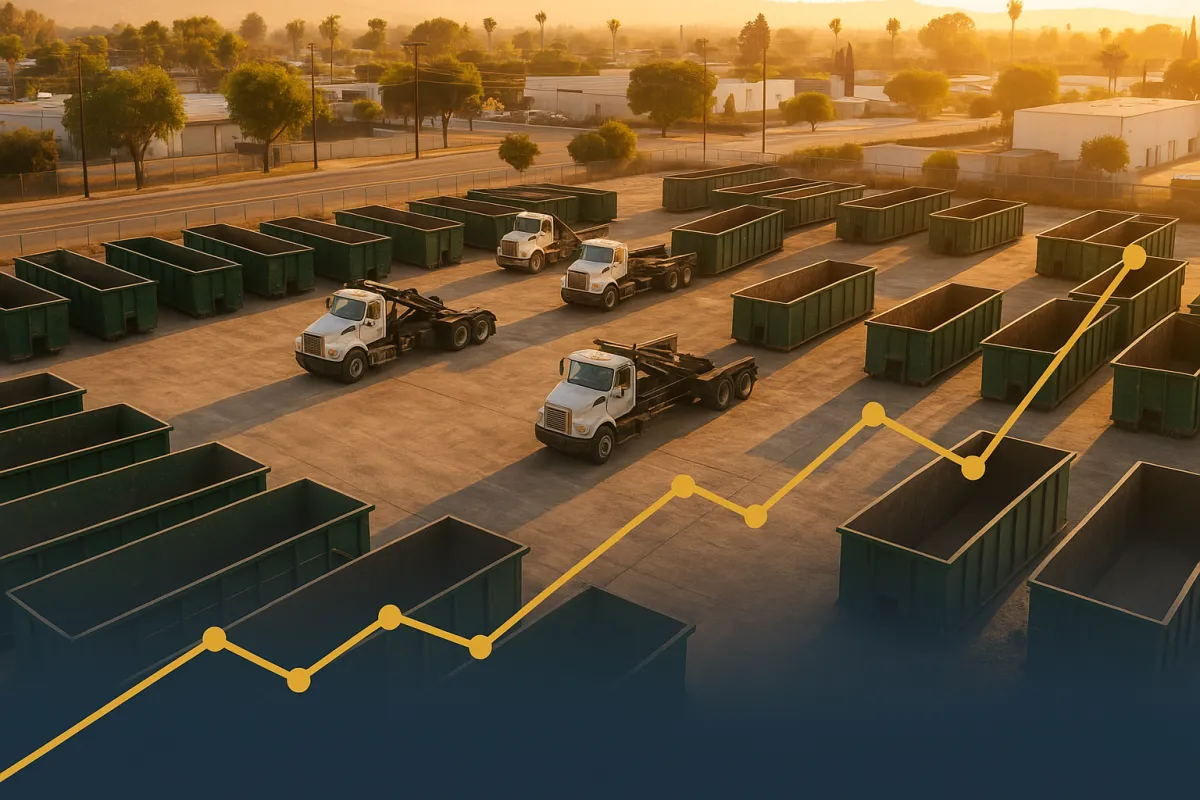
How a $6M Waste Hauler Improved Its Financial Position by $240K
From Unreliable Books to a $240,000 Turnaround: How a $6M/Year Southern California Waste Hauler Built a Business Worth Understanding
When a waste hauling and dumpster rental company in Southern California came to us, the business was already generating serious revenue. With multiple service lines, a growing team, and real operational infrastructure, the owner had built something most small business operators would be proud of. But the financial picture underneath that growth was harder to read than it should have been.
The books had inaccuracies that made monthly profit and loss statements unreliable. Strategic decisions about expansion, equipment, and staffing were being made without a clear picture of what the business was actually keeping. And a service line that had been running for years was quietly bleeding cash without anyone having the visibility to see it.
"We had the revenue. What we didn't have was a clear picture of whether we were actually building something, or just staying busy."
Over several months working together, we helped the owner of this Southern California waste hauling operation go from operating on gut feel and unreliable reporting to running a data-driven business with clean books, a validated financial model, and a strategy built on numbers we could actually trust. This is how that happened.
Where We Started: Two Companies, One Messy Picture
The business operated through two entities: the core dumpster rental operation and a service line that handled outsourced restroom services. On the surface, both were generating revenue. But when we looked at the consolidated books, the picture was significantly distorted.
The most critical issue was an accrual accounting mismatch. For the brokered service lines, income was being recorded in the correct period but the corresponding expenses were being booked on a cash basis when paid, not when the work was actually done. That timing gap was creating artificial losses in some months and inflated profits in others. In one month the restroom line showed $32,000 in income against $41,000 in expenses, a result that looked like a significant loss but was largely a bookkeeping timing artifact.
What We Found at the Start
Accrual accounting mismatches distorting monthly P&Ls, balance sheet discrepancies of several thousand dollars per month, a service line running at a loss without clear visibility into why, no consolidated reporting across both entities, and no reliable framework for strategic decisions about expansion or investment.
There was also no consolidated view of the two entities. The owner was managing two separate QuickBooks accounts and trying to reconcile them manually, which meant any analysis of total business performance required significant manual work before you could trust the numbers you were looking at.
Phase One: Building a Financial Foundation Worth Trusting
The first phase of the engagement was focused entirely on data integrity. We worked with the bookkeeper to correct the accrual accounting issues, tying outsourced vendor expenses directly to customer invoices so that revenue and costs were aligned in the same period. We validated the balance sheet against actual bank statements month by month, found and flagged discrepancies ranging from a few hundred dollars to several thousand per month, and built a corrected baseline.
We also built a new consolidated P&L dashboard that pulled live data from both QuickBooks accounts into a single view, with a mapping layer that standardized categories across both entities and prevented double-counting from intercompany transactions. For the first time, the owner could see the full business performance, both entities together, in a single report that updated automatically.
"Before we had this dashboard, I was making decisions based on numbers I wasn't sure I could trust. Now I can see exactly what the business is doing, across both companies, in one place."
That dashboard also became the tool that exposed one of the most consequential decisions the business made during the engagement. Once we could see the restroom service line clearly on an apples-to-apples basis, the data showed it was not generating the returns the business needed to justify its operational complexity.
Phase Two: The Decision That Changed the Financial Trajectory
The restroom service line had been running as an in-house operation. The team maintained equipment, managed logistics, and handled service directly. It was a significant operational lift, and when we modeled the true economics, the margins did not justify it.
We worked through the options together and helped the owner evaluate a shift to a broker model, where the company would still sell restroom services but fulfill them through outside vendors rather than running the operation in-house. The gross margin percentage on the broker model would appear higher on paper because the cost structure is different, but the more important point was that eliminating the operational overhead of an in-house restroom operation freed up both cash and management attention for the core business.
The shift was made in late 2025. The financial impact was measurable almost immediately. By Q1 2026, the restroom broker model was confirmed as more profitable on a true economics basis than the old in-house operation had been. The owner's core dumpster business, which had always been strong, was no longer being dragged down by the complexity and cost of maintaining a separate service line.
The Strategic Shift That Moved the Numbers
Transitioning the restroom service line from in-house operations to a broker model eliminated operational overhead and freed up management capacity. Combined with improvements to AR collections, the company's net financial position improved by approximately $240,000 year over year, moving from a negative reserve position to a positive one.
Is a Service Line in Your Business Quietly Costing More Than It Returns?
We can show you in one free call. No pitch, just an honest look at your numbers and where the real opportunities are.
No sales pressure · Just an honest look at your numbers
Phase Three: Turning Around a $240,000 Swing in Financial Position
One of the most tangible measures of the engagement's impact was a Wealth Waterfall analysis we ran tracking the business's net reserve position, cash plus tax savings minus debt, over 15 months. In March 2025, that number sat at negative $159,000. The company was carrying more obligations than it had in liquid reserves.
By March 2026, that same figure had moved to positive $84,000. A $240,000 improvement in overall financial position over 12 months, driven by three things: eliminating the drag of the restroom operation, a dedicated AR team that dramatically improved collections, and the financial discipline that comes from actually being able to see your numbers clearly.
The AR improvement alone was striking. Before the engagement, the owner spent close to an hour each week in collections review meetings trying to chase down outstanding receivables. After the AR process was overhauled and a dedicated team member was assigned to it, that meeting went from roughly 60 minutes to 18 minutes. Collections improved, the cash cycle shortened, and the weekly administrative burden on the ownership team dropped significantly.
"The AR collections change alone saved us an hour a week in meetings. More importantly, it actually got the money in the door faster."
Phase Four: Making Strategic Decisions From Data Instead of Intuition
With clean books, a reliable dashboard, and a clear picture of the business's financial position, the engagement shifted from remediation to strategy. The questions we were answering together became fundamentally different.
When the owner was evaluating whether to consolidate yards and move to a larger single location, we modeled it. The new yard offered a below-market rent rate and operational benefits including a covered mechanic bay that reduced downtime on the truck fleet. The net cost increase was approximately $2,000 per month. The operational benefits justified it. The owner made the call with confidence rather than instinct.
When the business was evaluating a significant truck purchase, we ran the numbers. A new truck at approximately $223,000 was evaluated against the company's capacity constraints and the financial case for bringing more outsourced volume in-house. We modeled the ROI, accounted for the financing cost, and built a forward projection that showed how the addition would affect cash flow through the business's predictable seasonal cycle.
That seasonal pattern was itself a major insight from the data. A four-year analysis of cash flow showed a consistent rhythm: strong cash generation from May through July, followed by a predictable slow season from August through December. Once we could see that pattern clearly, the strategy around it became obvious. Build reserves aggressively during the strong season to fund operations through the slow one, and set targets that the whole ownership team could manage toward.
Reserve Targets Built From Real Data
Based on four years of historical cash flow analysis, we set a reserve floor of $100,000 (enough to cover the typical slow-season cash burn) and a ceiling of $200,000 (roughly one month of total overhead). Those targets gave the ownership team a clear, data-driven framework for distribution decisions and investment timing.
Phase Five: Building for Scale
By early 2026, the engagement had moved into territory most small business owners never reach: building the financial infrastructure to support real scale. The owner was not just operating a cleaner version of the same business. He was thinking about franchising, about ERP systems, about the data architecture needed to run multiple locations with consistent financial visibility across all of them.
We began working on integrating the company's operational software directly with QuickBooks to create a single source of financial truth. The vision was to eliminate the manual reconciliation work that had been consuming the bookkeeping team's time, build automated reporting that pulled performance data in real time, and create a franchisee-level dashboard that would enable the owner to hold future operators accountable to the same financial standards the core business had built.
That is a different conversation entirely from where we started. It is the conversation a business owner gets to have when the fundamentals are right.
What This Engagement Actually Produced
The transformation this Southern California waste hauling business went through over the course of the engagement was not primarily about any single decision or any single month's results. It was about building the foundation that makes every future decision better.
A $240,000 improvement in net financial position year over year, confirmed by 15 months of Wealth Waterfall data
Elimination of a service line that was consuming more operational bandwidth than it returned
A consolidated P&L dashboard with live data from two entities, replacing manual monthly reconciliation
An AR process that cut weekly collections meetings from 60 minutes to 18 and improved cash cycle timing
Data-backed strategic decisions on yard consolidation, equipment investment, and seasonal reserve planning
A financial architecture being built to support franchising and multi-location scale
The owner started this engagement with a business that was generating real revenue but operating without the financial clarity needed to grow it intelligently. He ended it with a business he could actually see, understand, and steer.
That is what we do. We come into businesses that are working hard and help the owners understand what is actually happening financially so they can make smarter decisions with the same effort they are already putting in.
If your business is growing but the financial picture feels harder to read than it should be, the gap almost always comes down to the quality of the data and the systems around it. That is exactly where we start.
Ready to See What Your Business Could Actually Build?
Book a free call with our team. We will walk through your numbers and show you where the real opportunities are. No obligation, no pitch, just clarity.
Free call · No sales pressure · Just an honest look at your numbers