Construction Cash Flow Problems: Why You're Profitable But Always Broke
Here's the question we hear most often from construction business owners doing $2M–$10M in revenue:
"We had our best revenue year ever. So why am I constantly stressed about making payroll?"
If you've ever stared at a bank account that doesn't match what your P&L says you made, you're not mismanaging your business. You're experiencing a cash flow problem that's structural — and it's almost universal in the construction industry at this revenue level.
The bad news: it doesn't fix itself as you grow. In fact, it usually gets worse. The good news: it's completely solvable once you understand exactly where the gap is coming from.
This post is going to explain why construction businesses are chronically cash-poor despite being profitable on paper, show you the specific patterns that drain cash without showing up on your income statement, and give you the financial benchmarks to know whether your cash position is normal or a real problem. Then we'll talk about what actually fixes it.
Why Construction Has a Cash Flow Problem That Most Industries Don't
Construction is structurally different from almost every other type of business when it comes to cash flow — and most owners don't fully appreciate how much that difference matters until they're in the middle of a cash crunch.
In most businesses, the cash cycle is simple: you deliver a product or service, you invoice, you collect. In construction, the cycle looks more like this: you win a job, you mobilize your crew and order materials (spending real cash), you complete work over weeks or months, you submit a pay application, you wait for the GC or owner to approve it, you wait for them to actually pay — and then you collect.
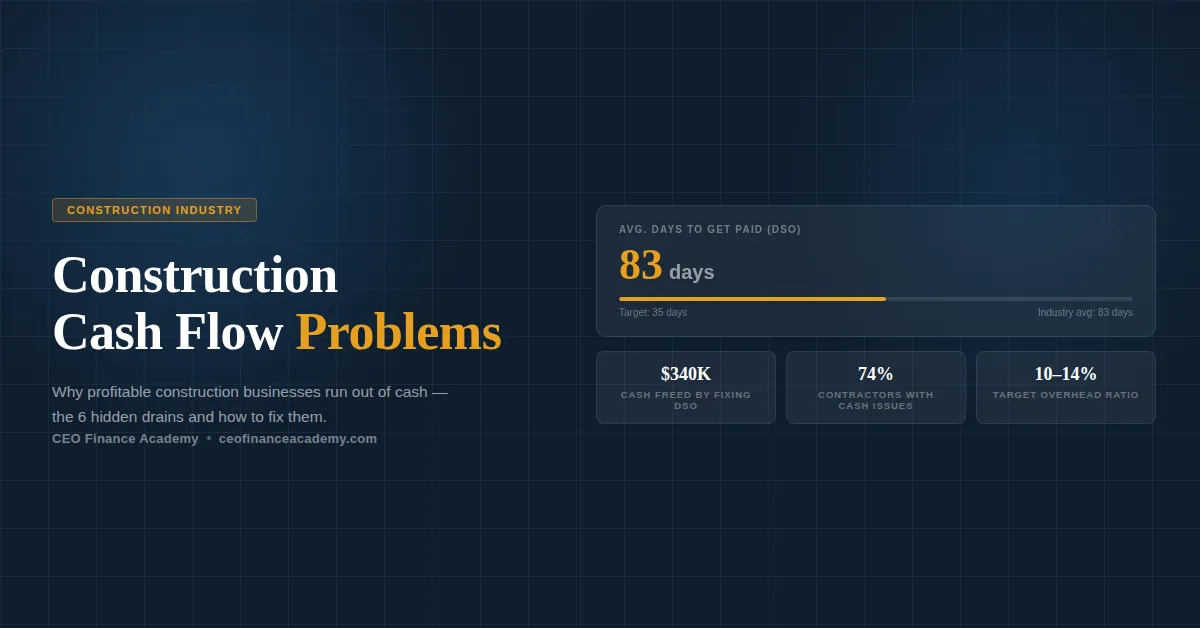
The average general contractor now waits 83 days to get paid. Subcontractors wait even longer. Meanwhile, your crew needs to be paid every two weeks, your materials supplier wants payment in 30 days, and your trucks don't care that your receivables are stuck in approval limbo.
According to a 2024 Dodge Construction Network report, 74% of construction companies experienced moderate to severe cash flow challenges, with delayed payments being the most common cause. A separate 2025 industry survey found that 43% of subcontractors report not having enough working capital to cover unexpected expenses or project delays.
This isn't a small business problem or a management failure. It's the structural reality of the industry. But understanding it is the first step to building a business that doesn't constantly feel like it's one slow-paying client away from a crisis.
The Difference Between Profit and Cash — and Why It Matters More in Construction
Your income statement (P&L) tells you whether your business is profitable. Your bank account tells you whether your business has cash. In most industries, these two numbers track reasonably closely. In construction, they can be wildly different — and that gap is where most of the stress lives.
Profit is an accounting concept. Cash is reality.
When you complete $400K worth of work in a month, your P&L records $400K in revenue — even if you haven't collected a dollar yet. If your direct costs for that work were $260K, your P&L shows $140K in gross profit. You look healthy. But if you paid your crew $80K out of pocket and your supplier $60K while waiting on payment, your actual cash position may have gotten worse, not better, that month.
This is the core paradox of construction finance: you can be profitable and cash-negative at the same time. And it gets worse at higher revenue — because larger jobs mean larger cash outlays before collection.
The Revenue Scaling Trap
Here's what nobody tells construction owners before they push for growth: every dollar of new revenue you add requires working capital to fund it. If your average collection cycle is 60 days and you grow from $3M to $5M in annual revenue, you've added roughly $333K in average outstanding receivables that need to be funded by your own cash or a credit line.
Growing a construction business without understanding cash flow math is like pushing the accelerator without checking the fuel gauge. You can be going fast right up until you're not going anywhere at all.
Construction Cash Flow Benchmarks: What Healthy Looks Like
Most construction owners have no baseline to compare against. Here are the key cash flow metrics we track for construction clients at CEO Finance Academy, and what the numbers should look like at different performance levels:
| Metric | Needs Work | Average | Strong | Best-in-Class |
|---|---|---|---|---|
| Days Sales Outstanding (DSO) | 75+ days | 55–75 days | 35–55 days | Under 35 days |
| Cash Reserve (months of opex) | Under 1 month | 1–2 months | 2–3 months | 3+ months |
| Overbilling Ratio (billing vs. costs) | Underbilled | Near even | Slightly overbilled | Consistently overbilled |
| Current Ratio (assets/liabilities) | Below 1.0 | 1.0–1.3 | 1.3–1.8 | Above 1.8 |
| Retainage as % of Revenue | Above 12% | 8–12% | 4–8% | Under 4% |
| Gross Profit Margin | Below 12% | 12–18% | 18–25% | Above 25% |
A few things worth noting about these benchmarks:
- Days Sales Outstanding (DSO) is the single most impactful metric for day-to-day cash health. Cutting DSO from 70 days to 45 days on a $5M business frees up roughly $340K in working capital.
- Most construction companies we encounter are unknowingly underbilling — meaning they've completed more work than they've invoiced. This is one of the fastest levers to pull for an immediate cash improvement.
- A current ratio below 1.0 means you have more short-term liabilities than short-term assets. This is a red flag that typically shows up before a serious cash crisis.
The 6 Hidden Cash Drains in Construction Businesses
When construction owners tell us they're cash-poor despite being profitable, it almost always traces back to one or more of these six patterns. None of them show up clearly on a monthly P&L — which is exactly why they're so dangerous.
1. Underbilling on Active Jobs
Underbilling happens when you've completed more work than you've invoiced. This is extremely common in construction — especially on time-and-materials jobs or when project managers delay submitting pay applications. The work is done, the cost is on your books, but the revenue isn't collected yet. You've essentially given your client an interest-free loan.
On a $5M company, even modest underbilling of 8–10% of revenue means $400–$500K of work sitting in limbo at any given time. That's a working capital hole that shows up as cash stress, not as a P&L problem.
2. Retainage Sitting Uncollected
Retainage — typically 5–10% of contract value held back until project completion — is one of the largest hidden cash drains in construction. A $5M company doing projects with 10% retainage could have $300–$500K in completed, earned revenue sitting in retainage at any given time. Many construction owners don't actively track and pursue retainage release — it gets collected eventually, but "eventually" doesn't make payroll.
3. Front-Loading Costs, Back-Loading Collections
Construction projects require significant cash outlay before substantial billings begin. Mobilization, materials procurement, early-phase labor — these costs hit weeks before your first pay application is approved. On a large project, you might spend $150K–$200K before collecting a dollar. Multiply that across several simultaneous projects and your cash position deteriorates fast, even as your backlog looks healthy.
4. Overhead Growing Faster Than Revenue
The construction industry averaged 14.8% gross margin for general contractors according to the 2024 CFMA Benchmarker — which means overhead management is not optional, it's survival. Every percentage point of overhead bloat on $5M in revenue is $50K off your bottom line. The most common trigger: hiring ahead of revenue growth, or adding fixed overhead (office space, admin staff, equipment payments) that doesn't flex down when a project ends.
5. Change Orders Being Done, Not Billed
Change orders are where construction margins are often made or destroyed. The problem: in the flow of a busy project, change order work gets done and often doesn't get formally priced, approved, and billed until weeks later — or sometimes never. Every unbilled change order is cash you've spent and revenue you haven't collected. On commercial projects, this can represent 10–20% of a project's total value.
6. Seasonal Cash Flow Ignored Until It's a Crisis
Construction revenue is seasonal in most markets. You're busy spring through fall and slower in winter — but your overhead runs 12 months. Most construction companies don't build a formal cash reserve during peak season to cover the winter gap. Then January hits, the pipeline is thin, and the owner is scrambling. This is entirely predictable with a rolling cash flow forecast. Without one, it hits like a surprise every year.
Notice that none of these six problems are about not being profitable. They're all timing and visibility problems — money you've earned that isn't in your account yet, or costs that outpace the cash they generate. That's why the fix isn't "make more revenue." It's building financial systems that manage the timing gap.
Think You Might Have a Cash Flow Gap?
Book a free call with our team. We'll look at your numbers together and show you exactly where your cash is going — and how to get it back.
→ Book My Free CallNo sales pressure · Just an honest look at your numbers
How to Fix Construction Cash Flow: What Actually Works
Here's what the construction companies we work with implement, in order of speed of impact:
1. Bill Faster and More Aggressively
The single fastest cash flow improvement in most construction businesses is tightening the billing cycle. Submit pay applications on the earliest allowable date — every time, without exception. Assign a specific person (or yourself) accountability for billing on schedule. Every week of delay on a $200K pay application is real cash sitting with your client instead of in your account.
2. Audit and Pursue Your Retainage
Build a retainage tracker — a simple spreadsheet showing every open project, the retainage amount, the expected release date, and who's responsible for initiating the release. Review it monthly. Actively pursue retainage as soon as punch list items are complete. Many construction owners are sitting on $200K–$500K of earned cash that they're simply not chasing hard enough.
3. Require Deposits on New Projects
For projects above a certain size, require a mobilization deposit — typically 10–20% of the contract value — before work begins. This shifts some of the cash cycle in your favor and filters out clients who aren't serious. Most well-run GCs and informed owners expect this. If a client pushes back on a reasonable deposit, that's information about how they'll handle the rest of the payment cycle.
4. Build a 13-Week Cash Flow Forecast
A 13-week rolling cash flow forecast maps every expected receipt and every expected payment out 90 days. It's the difference between reacting to a cash crisis and preventing one. When you can see a cash trough coming six weeks out, you have time to accelerate a billing cycle, draw on a line of credit, or defer a non-essential expense. Without it, you're flying blind until the account is empty.
5. Price Change Orders Before Doing the Work
Establish a firm company policy: no change order work begins until pricing is submitted and either approved in writing or acknowledged by the client. Yes, this is harder in practice than in theory — but even getting 80% of change orders priced upfront is dramatically better than billing them weeks later or absorbing them entirely. Track change order billings as a separate line in your monthly financial review.
6. Set a Target Overhead Ratio and Measure Monthly
For general contractors, target overhead at 10–14% of revenue. For specialty contractors, target 12–18%. Review actual overhead as a percentage of revenue every month — not just at year end when it's too late to adjust. When overhead creeps above your target, that's a decision point, not a line item to accept.
7. Build a Cash Reserve During Peak Season
During your highest-revenue months, intentionally set aside a portion of cash into a dedicated reserve account — not to invest, just to hold. A target of 2–3 months of operating expenses gives you a buffer that makes winter predictable instead of painful. Automate the transfer so it happens before you spend the cash on something else.
What Financially Healthy Construction Companies Look Like at $1M–$10M
Here's the financial profile of a well-run construction business at different revenue levels, based on the companies we work with directly:
| Metric | $1M–$2M | $3M–$5M | $7M–$10M |
|---|---|---|---|
| Gross Margin | 18–28% | 20–30% | 18–26% |
| Net Margin | 6–10% | 7–12% | 6–10% |
| Overhead Ratio | 12–18% | 13–18% | 14–20% |
| Average DSO | 35–55 days | 35–55 days | 40–60 days |
| Cash Reserve | 1–2 months opex | 2–3 months opex | 2–3 months opex |
| Owner Salary (in overhead) | $80–130K | $130–200K | $200–300K |
One pattern worth highlighting: net margin doesn't automatically improve as revenue grows in construction. We regularly see $8M construction companies running at 3–4% net — because overhead scaled with the business and nobody was managing the ratios. The companies at 8–12% net are not necessarily doing more work. They have better financial visibility and more disciplined systems.
Why This Problem Doesn't Fix Itself — and What Changes When You Have Financial Visibility
The cash flow challenges in construction are real, structural, and persistent. But they are not inevitable. The construction companies that operate with healthy cash positions aren't lucky — they're running tighter financial systems than their competitors.
They know their DSO. They track underbilling weekly. They have a 13-week cash forecast that gets reviewed every Monday. They know their overhead ratio and have a plan if it drifts. And almost without exception, they have someone in the financial co-pilot seat — whether that's a strong internal CFO, a fractional CFO, or a financial coach who understands the construction industry specifically.
The cost of not having this visibility isn't just stress. It's the decisions you make from a position of cash fear instead of cash clarity: the job you underbid because you needed the cash now, the equipment you financed at bad terms because the bank account was thin, the key employee you couldn't hire when you needed them. Those decisions compound over years into a business that's always running hard but never building real wealth.
The most common thing we hear from construction owners in the first 90 days of working with us is some version of: "I can't believe I didn't know this sooner."
The Bottom Line on Construction Cash Flow
If you're profitable on paper but cash-poor in practice, you are not failing at business. You are experiencing a predictable, solvable set of structural cash flow challenges that most construction companies at $1M–$10M face. The ones that break out of it share a few things in common:
- They bill faster and pursue collections aggressively, including retainage
- They build and review a rolling cash flow forecast — not just a monthly P&L
- They track overhead as a percentage of revenue and manage it proactively
- They price and bill change orders before the work is done
- They build cash reserves during peak season instead of spending everything they make
- They have someone in the financial co-pilot seat helping them see the full picture
None of these are complicated. But all of them require systems, accountability, and financial visibility that most construction owners are trying to build on their own — while also running crews, winning bids, managing clients, and doing everything else that comes with running a construction business.
That's exactly what we help construction companies build at CEO Finance Academy.
Ready to Stop Running Your Business on Cash Stress?
Book a free call with our team. We'll look at your cash flow together and show you exactly where the gaps are — and what it would take to fix them.
→ Book My Free CallFree call · No sales pressure · Just an honest look at your numbers