
Fractional CFO Services: What They Are, What They Cost, and Whether You Need One
You've got a bookkeeper handling your transactions. You've got an accountant filing your taxes. Revenue is climbing. And yet — every month feels like you're making financial decisions in the dark. You don't know what you can actually afford. You don't know if your profit margins are healthy or slowly eroding. You're not sure when you can hire, how much to pay yourself, or whether your business would survive a slow quarter.
"I'm doing over a million in revenue and I still feel like I'm guessing with every financial decision I make."
If that sounds familiar, you're not alone. We've worked with over 315 business owners across 40+ industries, and this is the single most common thing we hear in our first conversation. The gap between having someone record your numbers and having someone help you use your numbers to make decisions — that's the gap fractional CFO services fill.
This guide breaks down exactly what fractional CFO services are, what they cost (including our own pricing), who they're right for, and how to tell whether your business is ready for one.
What Are Fractional CFO Services, Exactly?
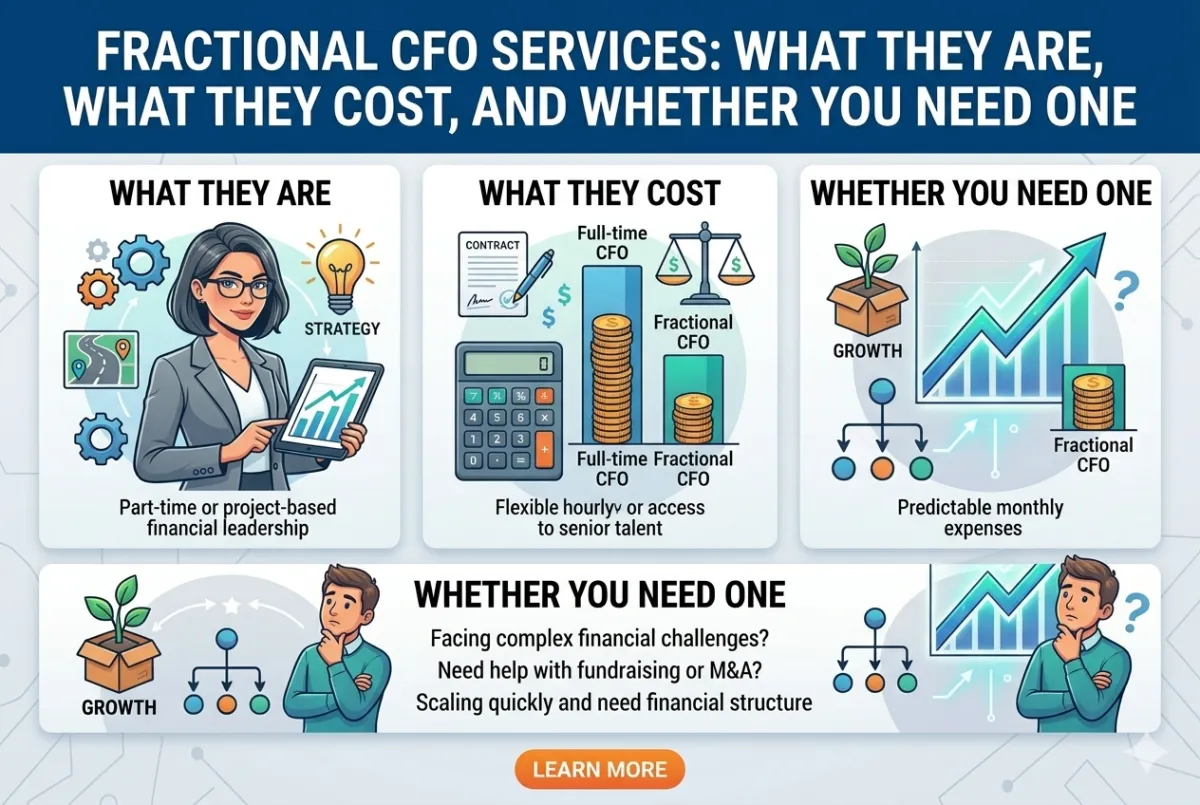
A fractional CFO is a senior-level financial strategist who works with your business on a part-time or contract basis — typically a few hours per week or a couple of calls per month — rather than as a full-time employee.
The word "fractional" just means you're getting a fraction of a full-time CFO's time. But you're getting the same caliber of financial leadership that a $250,000-a-year executive would bring to a Fortune 500 company.
Here's the important distinction most business owners miss: a fractional CFO is not a more expensive version of your bookkeeper or accountant. They occupy an entirely different role in your business.
Your bookkeeper looks backward
They record what already happened — categorizing transactions, reconciling bank statements, making sure the books are accurate. Their job is to produce clean data. That's it.
Your accountant looks backward and sideways
They take that data, make sure you're compliant with tax law, file your returns, and (if they're good) flag a few deductions you might have missed. Their job is to keep you legal and minimize your tax bill once a year.
A fractional CFO looks forward
They take all of that historical data and turn it into a decision-making tool. They build cash flow forecasts, profitability models, and financial dashboards that answer the questions your bookkeeper and accountant were never designed to answer: Can I afford this hire? What happens to my cash if I lose my biggest client? Am I pricing this service correctly? How much should I pay myself this quarter?
Key Distinction
Your bookkeeper tells you what happened. Your accountant tells the IRS what happened. A fractional CFO tells you what to do next — and builds the financial systems so you can see it for yourself.
What Does a Fractional CFO Actually Do?
Services vary by provider, but at CEO Finance Academy, our fractional CFO engagements typically include the following — and this is what we'd recommend you look for regardless of who you work with:
1. Rolling 12-month cash flow projections
This is the single most valuable deliverable. Instead of checking your bank balance and hoping for the best, you get a forward-looking projection that shows where your cash will be 3, 6, and 12 months from now — updated monthly as real numbers come in. This eliminates the "payroll anxiety" that keeps business owners up at night.
2. Monthly or bi-monthly CFO calls
A 60–90 minute strategic conversation where you review your numbers, discuss upcoming decisions, and build a plan for the next period. This isn't a report dump — it's an active conversation about what the data is telling you and what moves to make.
3. Custom financial dashboard
A centralized view of the 5–7 metrics that actually matter for your specific business: gross margin by service line, owner's compensation ratio, cash runway, accounts receivable aging, overhead as a percentage of revenue. The specific metrics depend on your industry and stage.
4. Profitability analysis by product, service, or department
Most business owners know their overall profit margin. Very few know which specific services, products, or departments are actually making money and which are quietly destroying margin. We've seen businesses shift their revenue mix by 15–20% after seeing this data for the first time — and add 3–5 points of net margin without generating a single dollar of new revenue.
5. Accounting team oversight
Your fractional CFO reviews the work your bookkeeper is producing, catches errors, and ensures the data feeding your decisions is actually clean. We've onboarded clients whose books were off by tens of thousands of dollars — and their bookkeeper had no idea.
6. Cash flow management training
The best fractional CFO doesn't create dependency — they build your financial literacy so you can read your own numbers and make confident decisions between calls.
"CEO Finance Academy is everything I thought a CPA and bookkeeper would check in on that they do not."
How Much Do Fractional CFO Services Cost?
Let's talk real numbers. There's a wide range in the market, and most providers are vague about pricing. We'll be transparent about ours and the industry at large.
Pricing Model | Typical Range | Best For | Watch Out For |
|---|---|---|---|
Hourly rate | $175–$450/hr | Project-based needs, one-time cleanups | Costs add up fast; no incentive for efficiency |
Monthly retainer | $3,000–$10,000/mo | Ongoing strategic support, most common model | Make sure scope is defined — "advisory" can mean anything |
Project-based | $10,000–$50,000+ | Fundraising, M&A prep, ERP implementation | Usually supplement to ongoing engagement, not standalone |
Our pricing at CEO Finance Academy
Our fractional CFO services run $3,500 to $6,000 per month depending on the complexity of your business, with a one-time $6,000 onboarding fee.
The onboarding fee covers the intensive first 30–60 days where we audit your current books, build your custom financial dashboard, create your initial 12-month cash flow projection, and get a baseline profitability assessment done. This is the heaviest lift — and it's where most of the immediate value gets unlocked.
After onboarding, the monthly retainer covers your CFO calls, updated projections, ongoing profitability analysis, accounting team oversight, and strategic guidance. You can see the full scope, process, and current pricing on our fractional CFO services page.
Cost Comparison
A full-time CFO costs $200,000–$350,000+ per year in salary, benefits, and equity. Our fractional CFO services cost a fraction of that while delivering the same strategic financial leadership for businesses in the $1M–$10M+ revenue range.
Is the onboarding fee worth it?
Honestly, it's where most clients find their first major financial insight. In that initial deep-dive, we routinely uncover $20,000–$100,000+ in annual savings, mispriced services, or cash flow leaks that the owner never knew existed. One roofing company client discovered that an entire job category they thought was profitable was actually losing money once true overhead was allocated — and they'd been aggressively bidding on more of that exact work.
Fractional CFO vs. Full-Time CFO: When Does Each Make Sense?
Not every business needs a fractional CFO. And not every business that needs financial leadership should go the fractional route. Here's how to think about it:
If you are not sure where your business falls, our guide to when a small business needs a CFO breaks it down by revenue stage.
Factor | Fractional CFO | Full-Time CFO |
|---|---|---|
Annual revenue | $500K–$20M | $15M+ |
Annual cost | $36K–$120K | $200K–$400K+ |
Time commitment | 2–8 hours/week | 40+ hours/week |
Best for | Strategy, forecasting, financial visibility | Daily financial operations, team management, investor relations |
Speed to impact | 30–60 days | 3–6 months (hiring + ramp-up) |
Flexibility | Scale up/down as needed, no long-term employment contract | Fixed overhead, harder to adjust |
The honest answer: if you're a business doing between $1M and $10M in revenue, a fractional CFO is almost certainly the right fit. You need the strategic thinking and financial systems, but you don't have 40 hours a week of CFO-level work to fill. You'd be paying a full-time salary for someone to spend half their time on work your bookkeeper should be handling.
If you're north of $15–20M with multiple entities, complex investor reporting, or a large finance team that needs direct management — that's when a full-time CFO starts making sense. And a good fractional CFO will tell you when you've outgrown them. If you need someone full-time but only for a few months, during a sale, a turnaround, or after a CFO leaves, that is an interim CFO. Our guide to fractional vs. part-time vs. outsourced vs. interim CFOs covers when each one fits.
Want to See What a Fractional CFO Would Actually Uncover in Your Business?
We'll walk through your numbers together on a free call — no pitch, just an honest look at where your cash flow stands and what opportunities might be hiding in your financials.
No sales pressure · Just an honest look at your numbers
7 Signs Your Business Is Ready for Fractional CFO Services
You don't need to check every box. But if three or more of these sound familiar, you're past the point where a bookkeeper and accountant alone can support the complexity of your financial decisions.
You're making revenue but don't feel like you're keeping enough of it. Your top line looks good on paper, but your bank account doesn't reflect it. You can't pinpoint where the money is going or why profit doesn't translate to cash.
You want to hire but don't know if you can afford it. You know you need more people to grow, but every new hire feels like a gamble because you can't model the true cost and payback period.
You've had an influx of revenue and don't know how to allocate it. More money is coming in, but you're unsure how much to set aside for taxes, how much to reinvest, and how much is safe to take home.
Your accountant only calls you during tax season. Nobody is proactively looking at your financial data between January and April. You're flying blind for 8 months of the year.
You don't know your profit margin by service line, product, or department. You know your overall margin (maybe), but you can't tell which parts of the business are carrying the weight and which are dragging it down.
You've been burned by financial surprises. An unexpected tax bill. A cash crunch you didn't see coming. A project that looked profitable but ate your margin. These are symptoms of operating without forward-looking financial systems.
You're thinking about selling your business — or want to be in a position to sell within 3–5 years. Buyers and investors look at very specific financial metrics. Without clean books, clear margins, and a demonstrated track record of profitability, your business is worth a fraction of what it could be.
What Industries Benefit Most from Fractional CFO Services?
Fractional CFO services work for virtually any business in the $500K–$20M revenue range, but there are certain industries where the impact tends to be especially pronounced — usually because cash flow timing, project-based revenue, or razor-thin margins make financial visibility critical.
At CEO Finance Academy, we've worked with over 315 companies across 40+ industries. The verticals where we see the fastest impact include:
Construction and roofing companies — progress billing, seasonal cash flow swings, and job costing complexity make financial leadership essential. One of our roofing clients discovered that an entire category of jobs was margin-negative after we implemented job-level profitability tracking.
Healthcare practices (dental, physical therapy, home health) — insurance reimbursement delays, high overhead, and multiple revenue streams create cash flow timing challenges that a bookkeeper alone can't solve.
Marketing and PR agencies — retainer revenue mixed with project work, scope creep eating margins, and the challenge of knowing true client-level profitability.
Ecommerce brands — inventory financing, COGS complexity, and the cash flow trap of scaling paid advertising while waiting for product margins to catch up.
Staffing agencies — the cash flow gap between paying employees weekly and collecting from clients on net-30/60 terms is one of the most dangerous in any industry.
Restaurants and hospitality — razor-thin margins (often 3–9% net), high labor costs, and seasonal volatility mean the difference between profitable and broke is often one or two percentage points of overhead control.
Online coaching and course businesses — launch-based cash flow cycles, high upfront marketing costs, and the challenge of knowing when to reinvest versus take profit.
How to Choose the Right Fractional CFO for Your Business
Not all fractional CFO services are created equal. Here's what we'd recommend looking for — and these criteria apply whether you're evaluating us or a competitor:
1. Industry experience matters more than credentials
A CPA who's spent 20 years in corporate accounting may have impressive credentials but zero understanding of how cash flow works in a $3M roofing company. Look for someone who has worked with businesses that look like yours — similar size, similar industry, similar challenges.
2. Ask about their deliverables, not just their time
Some fractional CFOs sell you hours. Others sell you outcomes. You want someone who will deliver specific things — a cash flow forecast, a profitability analysis, a financial dashboard — not someone who shows up for a monthly call and sends you a generic P&L summary.
3. They should teach, not create dependency
The best fractional CFO builds your financial literacy over time. After 12 months, you should understand your numbers better than you did on day one. If your CFO speaks in jargon you don't understand and never explains their methodology, that's a red flag.
4. Look for transparency in pricing
If a provider won't publish or clearly explain their pricing, that's a signal. Financial leadership should start with financial transparency — including about their own fees. You should know exactly what you're paying, what you're getting, and how the engagement scales over time.
5. Check for real client results
Testimonials are good. Case studies with specific outcomes are better. Ask any provider: "Can you show me a specific example of a business similar to mine where you measurably improved their financial position?" If they can't, keep looking.
What We Do Differently at CEO Finance Academy
We built CEO Finance Academy because we saw a gap in the market that frustrated us. Business owners were paying for bookkeeping and accounting — but nobody was actually teaching them how to use their financial data to make better decisions. They had data collectors, not financial partners.
Our approach is different from a traditional fractional CFO firm in a few specific ways:
We coach, not just consult. Our fractional CFO clients don't just receive reports — they learn to read, interpret, and act on their own numbers. We believe every business owner should be the most financially literate person in their company.
We pair fractional CFO services with accounting oversight. We review your bookkeeper's work, catch errors, and improve their processes — because a CFO's analysis is only as good as the data underneath it.
We've served 315+ companies across 40+ industries. That breadth of experience means we've seen the patterns. We know what "good" looks like for a $2M construction company versus a $5M ecommerce brand versus a $1M healthcare practice. We bring those benchmarks to your business.
We focus on profitability, not just reporting. Everything we do ladders up to four outcomes: increasing your company's profitability, making your business more sellable, giving you confidence in your margins, and mapping out your financial future.
"It's been phenomenal working with Alex & Will with my business finances. Before them, I didn't have a systematic way of handling it or even truly understand what impact it was having on my personal life."
The Bottom Line on Fractional CFO Services
A fractional CFO isn't a luxury for big companies. It's a practical, cost-effective way for businesses in the $500K–$20M range to get the financial leadership they need without the $250,000+ price tag of a full-time hire.
If your business has outgrown the "check my bank balance and hope for the best" stage of financial management, here's what you should take away from this guide:
Your bookkeeper and accountant serve important roles — but they were never designed to help you make forward-looking financial decisions. That's a CFO's job.
Fractional CFO services typically cost $3,000–$10,000 per month — a fraction of a full-time hire — and can deliver measurable ROI within the first 30–60 days through better pricing, cash flow visibility, and profitability analysis.
The best fractional CFO for your business has industry-specific experience, delivers concrete financial tools (not just advice), and builds your own financial literacy over time.
If you're experiencing cash flow unpredictability, can't clearly see margin by service line, or want to prepare your business for a future sale — you're ready.
That's exactly what we help business owners build at CEO Finance Academy — the financial systems, visibility, and confidence to make every decision from a position of clarity instead of anxiety. Here's how our fractional CFO services work.
Ready to See Where Your Business Actually Stands Financially?
Book a free cash flow forecast call with our team. We'll look at your numbers together and show you exactly where the opportunities are — whether you work with us or not.
Free call · No sales pressure · Just an honest look at your numbers