
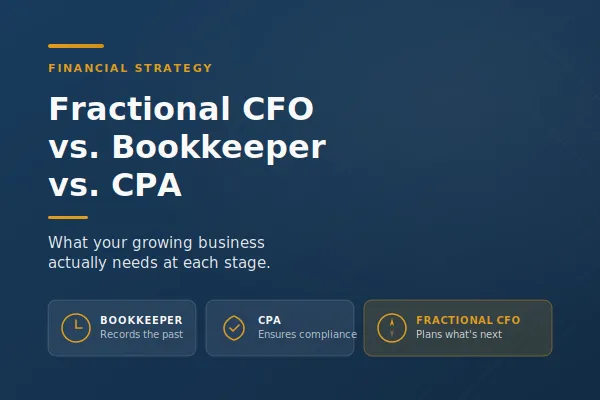
Fractional CFO vs. Bookkeeper vs. CPA: Who Does What?
You already have a bookkeeper. You already have a CPA. So why does it still feel like you're guessing every time you make a big financial decision?
"I pay my bookkeeper every month and my CPA every quarter. I figured between the two of them, my finances were covered. Turns out nobody was actually helping me plan."
That's one of the most common things we hear from business owners doing $500K to $10M in revenue. They have the right people in place for recording transactions and filing taxes. But when it comes to questions like "Can I afford to hire two more people?", "Should I take on this $400K project or pass?", or "Why did I do $2.5 million in revenue last year and still feel broke?"... nobody on their team is equipped to answer that. Not because the bookkeeper and CPA aren't good at their jobs. Because those questions aren't their jobs.
This post breaks down exactly what each of these three roles does, where the gaps are, and how to figure out which one (or which combination) your business actually needs right now.
The Three Roles, Explained Simply
The confusion between these roles is understandable. They all deal with your money. They all look at your financial statements. And depending on who you've hired, the lines can get blurry. But the core difference comes down to time orientation: one looks backward, one looks at right now, and one looks forward.
Your bookkeeper records what happened.
A bookkeeper's job is to make sure every transaction that flows through your business gets categorized correctly. Revenue in, expenses out, bank accounts reconciled, credit cards matched. They produce your profit and loss statement, your balance sheet, and your cash flow statement. Without clean books, nothing else works. A good bookkeeper is the foundation of your entire financial house.
But here's the thing: bookkeepers typically don't analyze what the numbers mean for your business decisions. They don't build forecasts. They don't tell you whether you can afford the hire you're considering or whether your pricing is right. They keep the scoreboard accurate. They don't call the plays.
Your CPA ensures you're compliant.
A CPA (or accountant, or tax advisor, depending on your setup) takes the books your bookkeeper produces and makes sure your taxes get filed correctly. They advise on entity structure, help you minimize your tax liability, and keep you out of trouble with the IRS. Some CPAs go further and offer light business advisory, especially around year-end tax planning.
Most business owners see their CPA two to four times a year: quarterly estimates, maybe a mid-year check-in, and the big push at tax time. The relationship is typically periodic rather than ongoing, and the focus is almost entirely on compliance and tax reduction. Your CPA can tell you what your tax bill will be. They usually can't tell you whether the marketing campaign you're running is generating a positive return, or how much runway you have if your biggest client delays payment for 60 days.
A fractional CFO (or financial coach) helps you plan and decide.
This is the role most business owners are missing and don't realize it. A fractional CFO sits inside your business on an ongoing basis, typically meeting with you weekly or biweekly, and focuses on one thing: using your financial data to help you make better decisions, faster.
That includes building cash flow forecasts, analyzing profit margins by service line, planning for hires, modeling what happens if you take on (or lose) a big account, figuring out what you should pay yourself, and holding you accountable to financial targets on a weekly basis. They're not recording transactions. They're not filing your taxes. They're turning the numbers your bookkeeper records and your CPA files into an actual operating plan for your business.
The Comparison at a Glance
Here's the simplest way to see how these three roles differ and where they overlap:
Dimension | Bookkeeper | CPA / Accountant | Fractional CFO |
|---|---|---|---|
Time orientation | Past (what happened) | Past (compliance review) | Future (what's coming next) |
Core function | Record transactions accurately | File taxes, ensure compliance | Financial planning, analysis, and strategy |
Meeting frequency | Ongoing (async or monthly) | 2-4x per year | Weekly or biweekly |
Key deliverables | P&L, balance sheet, reconciled accounts | Tax returns, entity advice, quarterly estimates | Cash flow forecasts, margin analysis, dashboards, hiring plans |
Typical cost | $300 - $2,500/mo | $2,000 - $8,000/yr | $2,000 - $10,000/mo |
Answers the question | "How much did we spend on materials in Q2?" | "How can we reduce our tax bill this year?" | "Can we afford to hire a project manager and still hit 12% net margin?" |
All three roles are valuable. This is not a post arguing that you should fire your bookkeeper or your CPA. You need both. But together, they still leave a critical gap in most growing businesses.
The gap is forward-looking financial guidance. Who is helping you make decisions about the future of your business based on real financial data, on a consistent basis? For most owners doing $500K to $5M, the honest answer is: nobody. That's the hole a fractional CFO fills.
These roles stack, they don't replace each other. The best-run companies have all three working together. The bookkeeper produces clean data, the CPA minimizes tax exposure, and the fractional CFO uses that data to drive strategy and accountability.
What Falls Through the Cracks When You Only Have a Bookkeeper and CPA
This is the part most business owners don't see until it's already cost them real money. When your only financial team is a bookkeeper and a CPA, you end up with accurate books and compliant tax returns, but zero financial strategy. Here's what that looks like in practice.
1. Nobody is watching cash flow proactively
Your bookkeeper can tell you what your bank balance was yesterday. Your CPA can tell you what you owed in taxes last quarter. But neither one is projecting your cash position 30, 60, or 90 days into the future. So when a slow-paying client and an unexpected equipment repair collide in the same month, you're scrambling. A fractional CFO would have flagged that gap six weeks before it happened.
2. Pricing decisions are made by gut feel
Most business owners set their prices based on what competitors charge, what feels right, or what the last client agreed to. Very few have done a real job-costing analysis that accounts for labor, materials, overhead allocation, and desired margin. Your bookkeeper can't do that analysis. Your CPA doesn't see it as their job. A fractional CFO does it before you send the next proposal.
If that sounds familiar, start with our guide to job costing for contractors.
3. Hiring decisions are made without financial modeling
Adding an employee costs more than just their salary. There's payroll tax, benefits, equipment, training time, and the revenue gap between when they start and when they're productive. Without someone modeling that, owners either hire too late (missing growth opportunities) or too early (straining cash flow). We've seen owners add $65,000 in payroll costs without realizing they needed $120,000 in additional revenue to break even on that hire.
4. You find out about problems three to six months too late
When your CPA reviews your year-end numbers and says "your margins dropped from 28% to 19% last year," that's useful information. But the margin compression happened in March. It showed up in your books by April. By the time your CPA reviewed it in January of the following year, you'd been operating at 19% for nine months without knowing it. A fractional CFO reviewing your numbers weekly would have caught it in the first month and helped you course-correct before it compounded.
5. There's no accountability for financial targets
Your bookkeeper isn't going to ask you why your gross margin dipped 4 points last quarter. Your CPA isn't going to push back when you say you want to buy a new truck. A fractional CFO will, because their entire role is to help you hit specific financial targets and to flag it immediately when you're drifting off course. That weekly accountability is, frankly, the thing most owners say they didn't know they needed until they had it.
The Expensive Gap
A business doing $2M in revenue with a 4-point margin leak that goes undetected for 9 months loses roughly $60,000 in profit that year. That's more than the annual cost of a fractional CFO, and it's just one example. Multiply this across pricing errors, bad hires, and missed cash flow warnings, and the cost of NOT having financial visibility adds up fast.
Wondering If Your Business Has a Financial Blind Spot?
We'll look at your current setup together and show you where the gaps are between what your bookkeeper and CPA handle and what your business actually needs.
No sales pressure · Just an honest look at your numbers
When Do You Actually Need a Fractional CFO?
Not every business needs one right now. If you're doing $150K in revenue, a good bookkeeper and a solid CPA are probably sufficient. But there's a point where the decisions get complex enough that flying without financial visibility becomes genuinely risky. Here's how to know if you're at that point.
Revenue Stage | What You Typically Need | Biggest Financial Risk |
|---|---|---|
Under $500K | Bookkeeper + CPA | Messy books, tax surprises |
$500K - $1.5M | Bookkeeper + CPA + financial coaching | Owner underpaid, no cash forecast, pricing by gut |
$1.5M - $3M | Bookkeeper + CPA + fractional CFO or financial coach | Margin compression, bad hires, cash flow gaps |
$3M - $10M | Bookkeeper + CPA + fractional CFO | Scaling without visibility, accounting team oversight, exit planning |
$10M+ | Full accounting team + fractional or full-time CFO | Organizational complexity, capital allocation, M&A readiness |
The $500K to $3M range is where most business owners hit the wall. You've outgrown the simplicity of just having a bookkeeper and CPA, but you're not big enough (or don't feel big enough) to justify CFO-level support. That feeling is based on what CFOs used to cost, not what they cost now. A full-time CFO runs $250,000 to $400,000 a year in total comp. A fractional CFO, working with you 2 to 4 times a month, typically runs $2,000 to $7,000 per month. For a $2M company, that's well within reach, and the ROI usually shows up in the first quarter.
Here are some specific signals that you've outgrown bookkeeper-and-CPA-only:
You've hired (or want to hire) 5+ employees and aren't sure how that changes your financial picture
You can't answer "what's my net margin by service line?" with confidence
You've had at least one cash flow scare in the last 12 months that caught you off guard
Your revenue has grown significantly but your take-home pay has stayed flat
You're making financial decisions based on your bank balance rather than a forecast
You're thinking about selling, bringing on a partner, or making a major capital investment
If three or more of those resonate, you're in the zone. And the longer you wait, the more those blind spots compound.
What This Looks Like in a Real Business
Let's make this concrete. Imagine a plumbing company doing $2.2M in revenue with 11 employees. The owner has a bookkeeper who reconciles the books monthly and a CPA who files taxes and handles quarterly estimates. Here's what the owner's financial week typically looks like without a fractional CFO versus with one:
Scenario | Without Fractional CFO | With Fractional CFO |
|---|---|---|
Cash flow visibility | Checks bank app daily, makes gut-feel decisions | Reviews 13-week cash forecast every Monday, plans around it |
Pricing | Matches competitors or marks up materials 2x | Knows exact margin on service calls vs. new installs vs. remodel projects |
Hiring | "I feel busy enough to hire someone" | Knows they need $18K/month in additional revenue to break even on the hire |
Owner pay | Takes whatever's left, varies month to month | Pays himself $11,500 on the 1st and 15th, non-negotiable |
Financial review | Looks at P&L when CPA sends it in January | Reviews KPIs with CFO every Tuesday for 45 minutes |
Problem detection | Finds out gross margin dropped in February... next January | Gets flagged within 2 weeks, adjusts pricing before it compounds |
Same bookkeeper. Same CPA. Same business. The only difference is someone sitting in the co-pilot seat looking at the numbers with the owner every single week. That's the layer that turns financial data into financial decisions.
What About a "Financial Coach"? Where Does That Fit?
You might have noticed that a few times in this post, I've used the phrase "financial coach" alongside "fractional CFO." That's intentional, because for a lot of owner-operated businesses in the $500K to $3M range, what you need isn't a traditional CFO who builds board decks and manages fundraising rounds. You need someone who teaches you how to read your own numbers, make decisions based on those numbers, and build the weekly habits that keep your business financially healthy.
That's what financial coaching is. It's the CFO role adapted for owner-operators who want to understand their finances, not just outsource them. Think of it this way:
Fractional CFO (traditional model): They do the financial work for you. Build forecasts, oversee your accounting team, create dashboards, run the numbers. Best for companies doing $3M+ where the complexity justifies having someone manage the financial function.
Financial coach: They teach you to do it alongside them. You meet weekly, look at the numbers together, and they walk you through the decisions in real time. You build the skills and the habits. Best for owners doing $500K to $3M who want to own their financial literacy, not just rent it.
Both models fill the same gap. The right one depends on your revenue, how hands-on you want to be, and whether you're at the stage where you need someone managing the function or someone training you to manage it yourself.
"CEO Finance Academy is everything I thought a CPA and bookkeeper would check in on that they do not."
How to Build Your Financial Team the Right Way
If you're starting from scratch or rethinking your current setup, here's the order that works for most service and trades businesses:
Step 1: Get a solid bookkeeper (Day 1)
This is non-negotiable from the moment your business generates revenue. Clean books are the foundation for everything else. If your bookkeeper is inconsistent, behind, or categorizing things incorrectly, no amount of CFO-level strategy can save you. You're building on sand. Look for someone who understands your industry (a bookkeeper who knows construction is very different from one who knows e-commerce), delivers monthly financials on time, and communicates clearly when something looks off.
Step 2: Add a CPA who knows your entity structure ($200K+ revenue)
Once your business is generating real revenue and you're paying yourself, tax planning becomes important. A CPA who understands whether you should be an LLC, S-Corp, or C-Corp, and who proactively plans your quarterly estimates and year-end strategy, will save you thousands in tax liability. The key word is proactive. If your CPA only calls you in March when the return is due, you're missing half the value.
Step 3: Bring in financial coaching or a fractional CFO ($500K+ revenue)
This is the inflection point. Once you've got clean books and a CPA handling compliance, the next leap in financial performance comes from someone who helps you actually use that data to run the business better. At $500K to $2M, that's typically a financial coach who meets with you weekly. At $3M+, it's often a fractional CFO who also oversees your bookkeeper and accounting processes. Either way, this is the hire that turns financial information into financial results.
The Cost Comparison
A full financial team for a $2M service business typically costs $3,500 to $6,000 per month total: roughly $500 to $1,500 for bookkeeping, $200 to $500 per month amortized for CPA fees, and $2,000 to $4,000 for financial coaching or fractional CFO support. That's 2% to 3.5% of revenue invested in financial visibility. The companies that make this investment consistently outperform those that don't, because every other decision in the business gets better when it's informed by real data.
The Bottom Line
Your bookkeeper and your CPA are both doing their jobs. The problem isn't that they're falling short. The problem is that there's an entire layer of financial work that doesn't belong to either of them, and in most growing businesses, nobody is doing it. That layer is the difference between knowing what happened last quarter and knowing what's going to happen next quarter. Between hoping your cash is okay and knowing it's okay. Between guessing on your next hire and modeling it.
Bookkeepers record what happened. They're the foundation. You need one from day one, and you need a good one.
CPAs handle compliance and tax planning. They keep you legal and minimize your tax bill. You need one by the time you're generating meaningful revenue.
A fractional CFO or financial coach handles strategy and accountability. They help you make better decisions, faster, by giving you forward-looking financial visibility on a weekly basis. You need one when the decisions start getting big enough that guessing can cost you $50K or more.
These roles don't replace each other. They stack. The best-run businesses have all three working together, each in their lane.
For most owner-operated businesses doing $500K to $10M, the CFO/coaching layer is the missing piece. It's the one that turns financial data into financial performance.
That's exactly the gap CEO Finance Academy was built to fill. If you're in the $500K to $3M range and you want to learn to manage your own numbers with someone guiding you weekly, our Academy coaching program is designed for that. If you're doing $3M+ and need a financial partner who builds forecasts, oversees your accounting team, and meets with you on a regular cadence, our fractional CFO services are built for exactly that stage.
Not Sure Which Level of Financial Support Your Business Needs?
Let's talk through it. We'll look at your current setup, your revenue, and your goals, and help you figure out the right next step. No obligation.
Free call · No sales pressure · Just clarity on what you need