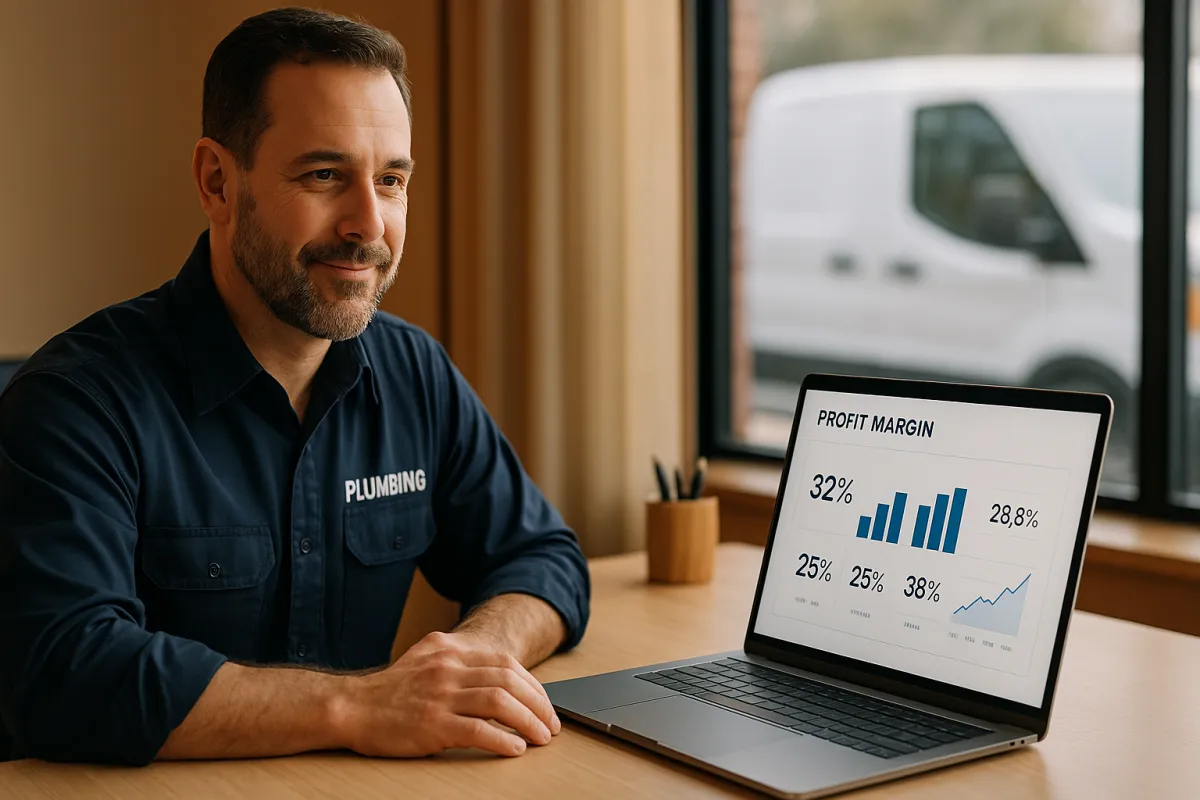
Plumbing Company Profit Margins: The Numbers That Separate a $1.5M Company Making $60K From One Making $200K
Your plumbing company did $1.5 million in revenue last year. You ran a full crew, answered the after-hours calls, kept the vans moving, handled the callbacks. And after paying your plumbers, your office manager, insurance, materials, marketing, and everything else, you took home about $60,000. That's roughly what one of your journeyman plumbers made.
The part that makes it worse is that you know there's a plumbing company two towns over doing the same revenue, in the same market, and the owner's pulling $180K to $200K. Same size crew. Same type of work. What you don't know is what they're doing differently.
This guide breaks down where plumbing profit margins should be, where most companies actually fall, why the gap exists, and what the highest-performing plumbing companies do that average ones don't. If you're doing $500K to $10M, every section is written for you.
Here's the thing most plumbing owners don't hear enough: plumbing is inherently a higher-margin business than most trades when run correctly. Equipment costs are lower than HVAC, material markup opportunities are better, and service work carries strong pricing power. The problem is that most plumbing companies don't capture those natural advantages because they price and manage their operations the same way they'd run any other trade.
Gross Margin vs. Net Margin: Two Numbers, Two Different Stories
These two numbers tell completely different stories. Most plumbing business owners only track one of them, or neither.
Gross profit margin is what's left after your direct job costs: plumber labor, materials, parts, fixtures, and any subcontractors you brought in. Say you bill $2,800 for a water heater replacement. Parts and materials cost $900. Labor costs $600. Your gross profit is $1,300 and your gross margin is 46%. The formula: (Revenue - Direct Job Costs) / Revenue x 100.
Gross margin tells you one specific thing: whether your jobs are priced correctly. It measures field-level profitability before your trucks, your office, your insurance, and every other cost of running the business enters the picture.
Net profit margin is what's left after all of that. Rent, trucks, fuel, insurance, office staff, marketing, software, your own salary, everything. The formula: (Revenue - ALL Expenses) / Revenue x 100. This is what actually hits your bank account at the end of the year.
Here's the insight that changes how most plumbing owners see their finances: you can run 55% gross margins on every job and still barely break even if your overhead is eating the difference. A $1.5M plumbing company with 50% gross margin and 46% overhead has a 4% net margin. That's $60,000. The same company with 50% gross margin and 35% overhead has a 15% net margin. That's $225,000. The gross margin didn't change. The overhead did. That's why you need both numbers.
Plumbing Profit Margin Benchmarks: Where Do You Stand?
Here's what the industry data shows, pulled from contractor coaching groups, financial reviews across hundreds of plumbing P&Ls, and what we see directly in the companies we work with.
| Metric | Needs Work | Average | Strong | Best-in-Class |
|---|---|---|---|---|
| Gross Profit Margin | Under 40% | 40–48% | 50–58% | 60%+ |
| Net Profit Margin | Under 5% | 5–10% | 12–16% | 18–25% |
| Overhead as % of Revenue | Over 42% | 34–42% | 26–32% | Under 26% |
| Revenue per Plumber | Under $150K | $150K–$220K | $240K–$350K | $350K+ |
| Owner's Total Compensation | Under $60K | $60K–$100K | $110K–$180K | $180K+ |
A few things stand out when you look at where these numbers actually land:
- The average plumbing company nets between 5% and 10%. Many industry sources put the true average closer to 5% to 8%. If you're in this range, you're working extremely hard for very little return. A $1.5M company netting 6% keeps $90,000 after running an entire operation with real liability, real risk, and real hours behind it every week.
- Best-in-class plumbing companies hit 18% to 25% net margins. On $1.5M in revenue, the difference between 5% and 18% is $195,000 per year. Same trucks. Same market. Same service calls. The gap isn't about who works harder. It's about how the business is managed financially.
- Plumbing business owners typically earn between $70,000 and $120,000 per year. Owners of well-run companies with strong margins and multiple crews can exceed $180,000 to $200,000+. The difference is almost entirely margin management, not revenue size.
Margins by Service Type: Where Plumbing Gets Interesting
This is where most plumbing owners have a complete blind spot. Your blended gross margin might look fine at 46%. But when you break it apart by service type, you'll almost always find one category carrying the rest.
| Service Type | Typical Gross Margin | Revenue per Job | Notes |
|---|---|---|---|
| Drain Cleaning | 60–75% | $150–$400 | Highest margin, low material cost, strong pricing power |
| Emergency/After-Hours Service | 55–70% | $250–$800 | Premium pricing justified by urgency |
| Service & Repair Calls | 48–60% | $200–$1,200 | Bread and butter, solid margin |
| Water Heater Replacement | 40–52% | $1,500–$4,500 | Equipment cost compresses margin |
| Repiping / Remodeling | 30–45% | $3,000–$15,000+ | Higher ticket but labor-intensive, longer timelines |
| New Construction Plumbing | 15–28% | $3,000–$12,000 | Lowest margin, competitive bidding, slow collections |
Drain cleaning and emergency service are your highest-margin categories by a wide margin. Material costs are minimal, labor is efficient, and customers don't shop three bids when their sewer is backing up at 9 PM. Meanwhile, new construction plumbing often runs at 15% to 28% margins with 60 to 90 day payment cycles. Many plumbing companies chase new construction because the revenue numbers look big, but they're tying up their best plumbers on the lowest-margin work while leaving high-margin service calls on the table.
A pattern worth paying attention to: The most profitable plumbing companies we work with generate at least 40% to 50% of their revenue from service, repair, drain cleaning, and maintenance agreements. They treat new construction as supplemental, not core. This single shift in revenue mix is often the difference between a 6% net margin and a 16% net margin.
The 6 Margin Killers in Plumbing Companies
Most plumbing owners can feel that the margins aren't where they should be. The harder part is diagnosing exactly why. These six patterns come up in nearly every plumbing P&L we review.
1. Pricing Based on Competitors Instead of Your Actual Costs
Every plumbing company has different overhead, different labor costs, different truck expenses. When you price based on what the shop down the street charges, you're inheriting their cost structure. If their overhead is 28% and yours is 40%, matching their price means you lose money on every call they turn a profit on.
The fix is building your flat rate price book from your actual fully-loaded labor rate: plumber wages plus burden rate (payroll taxes, workers' comp, benefits) plus truck cost plus overhead allocation per hour. Add materials at a proper markup (25% to 40%), then layer your target profit margin on top. Your prices need to come from your numbers, not someone else's.
2. The 2-to-5 Plumber Overhead Trap
Solo plumbers often net 15% to 25% because they carry almost no overhead. Add 2 to 5 employees and overhead explodes: dispatcher, office help, warehouse space, additional trucks, more insurance, admin support. Revenue doesn't scale fast enough to absorb all of it, and net margin craters to 3% to 6%.
This is the most dangerous growth stage in a plumbing company. You hired more people to grow, but the new revenue hasn't outpaced the new cost of supporting it. The way through is knowing your numbers well enough to add revenue in the highest-margin categories first before layering on more overhead.
3. Not Charging Enough for Emergency and After-Hours Work
Emergency plumbing commands premium pricing because the customer genuinely has no other option. A burst pipe at 11 PM on a Saturday is not a price-shopping moment. Yet many plumbing companies charge the same rate for emergency calls as they do for a standard Tuesday afternoon job.
After-hours calls should carry a 50% to 100% premium. That $200 service call at 2 AM should be $350 to $400. Your plumber is giving up their night. Your customer is getting their crisis resolved. The premium is earned, and most customers in an emergency fully expect it. If you're not charging it, you're subsidizing someone else's problem at the cost of your own margin.
4. Underinvesting in Maintenance Agreements and Membership Programs
Maintenance agreements (annual inspections, priority scheduling, discounted rates for members) generate 55% to 70% gross margins, create predictable recurring revenue, and smooth out the slower months of the year. The best plumbing companies generate $100 to $200 per member per year from a well-structured VIP or membership program.
If you have fewer than 150 active agreements and you're doing $1M or more in revenue, you're leaving serious money and cash flow stability on the table. A base of 300 members generating $150 per year adds $45,000 in near-pure-margin revenue annually. Those members also call you first without shopping, which means higher-ticket follow-on work without any additional marketing cost to acquire it.
5. Chasing New Construction Volume at the Expense of Service Margins
New construction plumbing often feels like the big opportunity because the project totals are large. But margins are thin (15% to 28%), collections are slow (60 to 90 days), and your most experienced plumbers spend weeks tied up on job sites.
Every service call, drain cleaning job, and water heater replacement you turn away because the crew is on a new construction site is a 50% to 65% margin opportunity walking straight to your competitor. The most common margin mistake we see in plumbing companies is letting construction volume dominate the revenue mix. The revenue looks impressive. The net profit at year's end tells a different story.
6. Not Tracking Margins by Service Type at All
This is the root cause underneath everything else. If you only see a blended margin number on your P&L, you can't tell which service types make money and which don't. You can't price correctly because you don't know your true cost by category. You keep saying yes to work that feels productive but is actually pulling your average margin down.
The first step to fixing it is splitting your P&L into at least three categories: service and repair, replacements (water heaters, repiping), and new construction. Once each category is visible on its own, the decisions become obvious. Until then, you're making pricing and sales decisions without the information you actually need.
What a $1.5M Plumbing Company Looks Like: Average vs. Well-Run
Let's put real dollars on this. Two versions of the same $1.5M plumbing company, side by side. Same market, same number of plumbers. The only difference is how the finances are managed.
| Metric | "Getting By" at $1.5M | "Dialed In" at $1.5M |
|---|---|---|
| Gross Profit Margin | 42% | 56% |
| Gross Profit (dollars) | $630,000 | $840,000 |
| Overhead | $570,000 (38%) | $420,000 (28%) |
| Net Profit | $60,000 (4%) | $270,000 (18%) |
| Owner's Total Comp | $58,000–$75,000 | $160,000–$220,000 |
| Cash Reserve | $12,000 (less than 2 weeks) | $100,000+ (3 months overhead) |
| Revenue per Plumber (4 plumbers) | $187,500 | $300,000 |
| Maintenance Agreement Members | 40 | 350+ |
| Revenue Mix (service vs. construction) | 35% service / 65% construction | 60% service / 40% construction |
The "Getting By" company has the same revenue. Same market. Probably the same level of technical skill on the tools. But the owner takes home $60K while doing the same amount of work as the owner taking home $200K+. The biggest difference isn't effort. It's revenue mix (more service, less construction), pricing discipline (flat rate built from real costs, not competitor matching), and financial visibility (weekly review of margins by service type, not a scramble at tax time).
This profit-vs-cash disconnect is exactly why so many plumbing owners feel cash-strapped even when the P&L says they're profitable. We break down the 7 reasons this happens in our guide to why businesses are profitable on paper but never have cash.
Want to see what your plumbing company's margins actually look like when we break them apart by service type? Let's sit down together and find out.
Book My Free Cash Flow CallNo sales pressure. Just an honest look at your numbers.
How to Actually Improve Your Plumbing Margins
Benchmarks are useful. Knowing where you stand is the starting point. But knowing the gap doesn't close it. Here's what actually moves the number.
1. Break Your P&L Into Service Categories
At minimum, separate your P&L into three buckets: service and repair, replacements (water heaters, fixtures, repiping), and new construction. Add drain cleaning and maintenance agreements as separate line items if you can get there.
Once each category is visible on its own, you'll know exactly where money is made and where it quietly disappears. This doesn't require a new accounting system. It requires consistent job costing and a bookkeeper who codes expenses to the right category every time. The visibility alone changes how you make every other decision on this list.
2. Rebuild Your Flat Rate Price Book From Real Costs
Start with your fully-loaded labor cost per hour: plumber wages plus payroll taxes plus benefits plus workers' comp plus truck cost plus overhead allocation. Add materials with a 25% to 40% markup. Then add your target profit margin on top.
If you haven't rebuilt your price book in the last 12 to 18 months, your prices are almost certainly too low. Materials have climbed. Insurance has climbed. Wages have climbed. Your prices need to reflect what it actually costs to run your business right now, not two years ago when you last set the book.
3. Push Maintenance Agreements Aggressively
Structure a tiered program: basic annual inspection ($150 to $200 per year), mid-tier with priority scheduling and a discount on repairs ($300 to $400 per year), premium with emergency coverage included ($500 to $750 per year). Target 300+ active members by the time you hit $1.5M in revenue.
These programs generate 55% to 70% gross margins and create the kind of predictable, recurring revenue that smooths seasonal cash flow swings. A member who calls you for a drain cleaning is also the person who calls you when the water heater fails at the worst possible time. They're not shopping. They're loyal. And they're your highest-value customer.
4. Shift Your Revenue Mix Toward Service and Away From New Construction
This doesn't mean cutting construction out entirely. It means being intentional about the ratio. Target at least 50% of revenue from service, repair, drain cleaning, and maintenance work.
Reallocate marketing toward service-focused keywords: drain cleaning near me, emergency plumber, water heater repair. Train your technicians to identify opportunities on service calls and convert them into water heater replacements and repipe consultations. Every service call has upsell potential at 50%+ margin, if your team knows how to have the conversation.
5. Track Revenue per Plumber Weekly
Revenue per plumber is the simplest proxy for field productivity you have. If one tech is generating $30K a month and another is generating $15K on similar call volume, that's a training, efficiency, or upsell skills gap you can find and close. Post the numbers. Make them visible to the whole team.
Revenue per employee is one of the five financial KPIs we recommend every business owner review on a weekly basis. We break down all five in our weekly KPIs guide.
6. Review Your Numbers Weekly, Not at Tax Time
Monthly reviews are too slow. A margin problem that shows up in February but doesn't get caught until March has already cost you 4 to 6 weeks of profit. The best plumbing companies run a weekly dashboard: revenue vs. target, gross margin by service type, cash position, outstanding receivables, and callback count.
Thirty minutes a week. That's all it takes. Once you build the habit, you can't imagine making decisions without it.
Why Financial Visibility Is the Real Difference Maker
The plumbing owners who consistently hit "strong" or "best-in-class" on those benchmarks almost always have someone helping them review the numbers every week. Not once a year when the CPA files the return. Not once a quarter. Every single week.
That kind of consistent financial partnership changes how you operate. Instead of reacting to cash crunches, you see them coming two months out. Instead of guessing whether a new service van makes sense, you're running the actual numbers before signing anything. That's what a financial coach or fractional CFO provides, and if you're still sorting out which type of support makes sense for where you are right now, we break down the differences in our comparison guide on bookkeepers, CPAs, and fractional CFOs.
Here's a quick way to put a real dollar figure on the cost of not having that visibility. Take the difference between your current net margin and 15%. Multiply it by your annual revenue. For a $1.5M plumbing company running at 5%, the gap is 10 points, which is $150,000 per year. Over 5 years, that's $750,000 in profit that was available and never captured. That number lands differently every time a business owner actually sits down and does the math.
Most plumbing business owners we work with are also underpaying themselves relative to what their company can actually support. If you want the right benchmarks for owner compensation at different revenue levels, we walk through the full picture in our guide to paying yourself as a business owner.
The Bottom Line on Plumbing Profit Margins
- Plumbing is a naturally higher-margin trade than most. Equipment costs are lower, material markups are better, and service work carries strong pricing power. If your margins don't reflect that, it's a management issue, not a market issue. The opportunity is there. Most companies just aren't set up to capture it.
- Target 50%+ gross margins on service and drain cleaning, 40%+ on replacements. If new construction is pulling your blended margin below those numbers, the fix is adjusting the revenue mix, not accepting thin results across the board.
- Know your net margin and track it every month. The best plumbing companies hit 18% to 25%. The industry average is under 8%. On $1.5M in revenue, that gap is more than $150,000 per year that either stays in your business or quietly disappears into overhead.
- Build your maintenance agreement base aggressively. This is your highest-margin service category, your best hedge against seasonal slowdowns, and your most predictable revenue stream. Three hundred active members changes the financial profile of your entire company.
- Get someone in the co-pilot seat. The owners who consistently break through to double-digit net margins have someone reviewing the numbers with them every week. Not occasionally. Every week.
That's exactly what we build with plumbing company owners at CEO Finance Academy. Whether you want to learn your own numbers through our weekly coaching program or you need a fractional CFO building rolling forecasts and managing your financial operations at a higher level, the process starts the same way: we look at where your margins are, where they should be, and what's sitting in between.
Ready to find out where your plumbing company's margins are really leaking? Book a free Cash Flow Call. We'll break down your margins by service type, show you the biggest opportunities, and map out what your company could look like at 15%+ net margin. No pitch. Just an honest look at your numbers.