
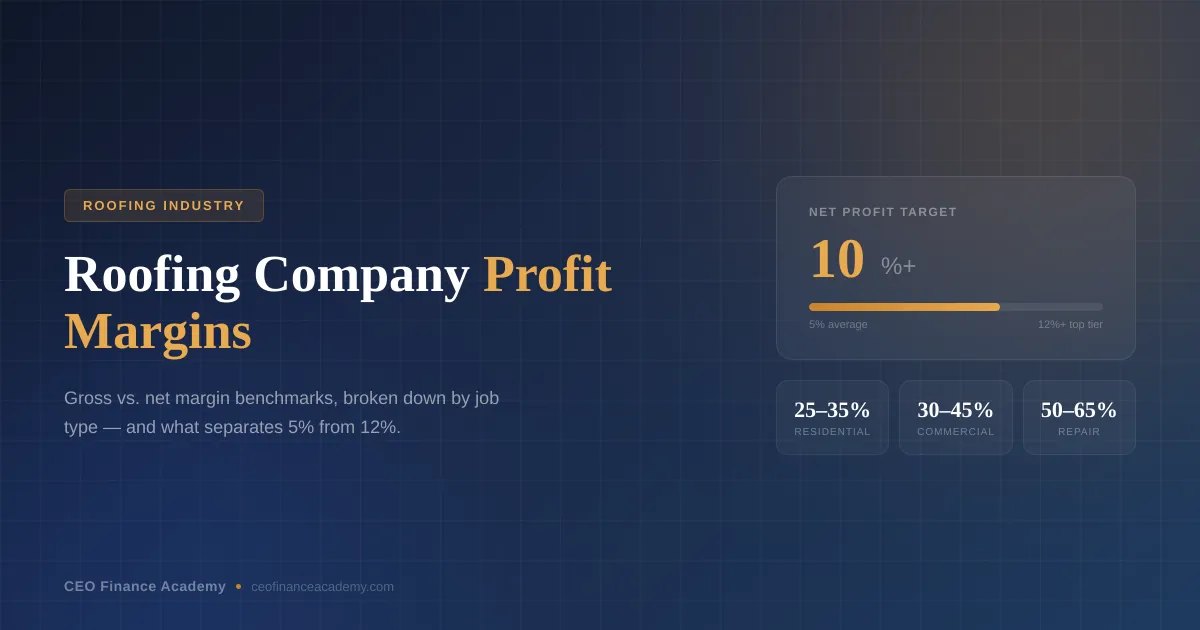
Roofing Company Profit Margins: 2026 Benchmarks & Owner Pay
Here's a question we hear from roofing company owners constantly:
"We did $4 million this year. So why does it feel like I barely made anything?"
If that hits close to home, you're not alone, and you're not bad at business. The roofing industry has a profit margin problem nobody talks about honestly: the numbers thrown around online (20–40%!) are gross margin figures, not what actually lands in your pocket at the end of the year.
This guide breaks down roofing profit margins the way your CFO should explain them: gross vs. net, by job type, by revenue size, what a roofing company actually makes per house, and what owners really take home. Then we'll show you what separates a 5% net margin roofing company from a 12% one, because the gap isn't luck.
Gross Profit Margin vs. Net Profit Margin: Why the Difference Matters
Most articles about roofing profit margins cite figures between 20% and 40%. Those are gross profit margins, and while they're useful, they're not the number that determines whether you're actually building wealth.
Gross profit margin
Gross profit margin measures what's left after your direct job costs (labor and materials) are subtracted from revenue. It does not include overhead.
Gross margin = (Revenue − Direct Job Costs) ÷ Revenue × 100
Example: you complete $500K in roofing jobs in a month. Materials cost $160K and labor costs $120K. Your gross profit is $220K, a 44% gross margin. Sounds great. But you still haven't paid for your trucks, insurance, office staff, marketing, or yourself.
Net profit margin
Net profit margin is what's left after everything (overhead, a market-rate owner salary, and all operating costs) is paid. This is the number that tells you whether your business is creating wealth.
Net margin = Net Income ÷ Revenue × 100
Same example: after $180K in monthly overhead (office staff, marketing, vehicles, insurance, owner pay), net income drops to $40K, a net margin of just 8%.
Why This Matters: It's entirely possible to run a $5M roofing company with a 35% gross margin and a 4% net margin. You look profitable on paper but you're barely ahead. It's the trap most roofing owners don't see until someone looks at their full financial picture.
Roofing Profit Margin Benchmarks: Average vs. Good vs. Best-in-Class
Based on industry data from the NRCA, Roofing Contractor magazine, and our own work with roofing companies at CEO Finance Academy, here are the benchmarks to measure yourself against:
Metric | Needs Work | Average | Strong | Best-in-Class |
|---|---|---|---|---|
Gross Profit Margin | Below 30% | 30–35% | 35–42% | 42–50%+ |
Net Profit Margin | Below 5% | 5–8% | 8–12% | 12–15%+ |
Overhead as % of Revenue | Above 35% | 28–35% | 22–28% | Below 22% |
Labor Cost as % of Revenue | Above 35% | 28–35% | 22–28% | Below 22% |
Materials as % of Revenue | Above 40% | 32–40% | 26–32% | Below 26% |
The average roofing contractor nets very little. The NRCA reports the average roofing contractor nets just 2.8%, so half of all roofing companies make less than that. The industry average is not a good target.
A good net profit margin for a roofing company is 8% to 12%, after overhead and a real owner salary. Strong performers aren't necessarily doing more revenue. They have better systems, pricing discipline, and visibility into their numbers.
Best-in-class roofing companies (12%+ net) almost always manage overhead intentionally and track profitability job by job, not just with a monthly P&L from their accountant.
Not sure where your company lands? Our free Profit Margin Checkup takes about a minute. Enter a few numbers from last year and it compares your net margin to these roofing benchmarks, then shows what the gap is worth in dollars.
Roofing Profit Margin by Job Type: Not All Roofing Work Is Equal
This is the insight most roofing owners are missing. Your overall gross margin is an average, and it can mask the fact that some job types are very profitable while others are quietly destroying your margins.
Job Type | Typical Gross Margin | Typical Net Margin | Complexity |
|---|---|---|---|
Residential repair / service | 45–55% | 15–20% | Low |
Residential re-roof (retail) | 35–45% | 10–15% | Medium |
Insurance restoration | 30–40% | 8–14% | Medium-High |
Commercial (small) | 28–38% | 8–13% | Medium |
Commercial (large scale) | 20–30% | 5–10% | High |
New construction | 18–28% | 4–9% | High |
Residential repairs and service work are almost always your highest-margin jobs. New construction and large commercial work often look impressive on revenue but erode margins fast once you factor in true overhead absorption, longer payment cycles, and the complexity of managing larger crews.
We've seen roofing companies shift 20% of their revenue mix from new construction toward residential service and re-roofing and increase net profit by 3–4 percentage points without adding a single dollar of revenue.
The Job Costing Problem: Most roofing owners don't know their margin by job type because they look at a monthly P&L, not job-level data. A monthly P&L tells you how the whole company did. Job costing tells you which work is actually making you money, and that's a completely different conversation.
Roofing Profit Margins by Revenue Size: $1M to $10M
Here's a profile of a well-run roofing business at different revenue levels, based on what we see in our CFO client work:
Metric | $1M–$2M | $3M–$5M | $7M–$10M |
|---|---|---|---|
Gross Margin | 35–42% | 38–44% | 36–42% |
Net Margin | 7–11% | 9–13% | 8–12% |
Overhead Ratio | 24–30% | 25–30% | 27–33% |
Owner Salary (in overhead) | $80K–$120K | $120K–$180K | $180K–$250K |
Cash Reserve Target | 1–2 months opex | 2–3 months opex | 2–3 months opex |
Net margin doesn't automatically improve as revenue grows. Some of the tightest-margin roofing companies we've seen are $8M+ businesses running a 4% net, because overhead scaled with revenue and nobody managed the ratio. Bigger doesn't mean more profitable. Better-managed does.
Want to Know Where Your Margins Actually Stand? Book a free 30-minute call with our team. We'll look at your P&L together and show you exactly where the opportunities are.
No sales pressure. Just an honest look at your numbers.
How Much Does a Roofing Company Make? Per House and for the Owner
Two of the most common questions we get: how much does a roofing company actually make on a job, and how much do roofing company owners take home? Here's how to think about both.
Profit per house: a worked example
Take a $15,000 residential re-roof. At a 40% gross margin (typical for retail re-roofs), the job produces $6,000 in gross profit after materials and crew labor. Now allocate overhead. If your overhead runs 28% of revenue, that job has to carry $4,200 of trucks, insurance, office staff, marketing, and owner salary. What's left is about $1,800 in net profit, or 12%.
$15,000 Re-Roof | Average Company | Well-Run Company |
|---|---|---|
Gross Margin | 32% ($4,800) | 40% ($6,000) |
Overhead Carried (% of revenue) | 30% ($4,500) | 28% ($4,200) |
Net Profit per Job | $300 (2%) | $1,800 (12%) |
Same house, same roof, same price. The difference between $300 and $1,800 per job is pricing discipline and overhead control. Multiply that by 200 jobs a year and it's the difference between $60,000 and $360,000 in profit.
How much roofing company owners make
A roofing company owner's real earnings are two things added together: a market-rate salary paid through the business, plus the net profit the business produces. Using the benchmarks above, a well-run $3M–$5M roofing company pays its owner $120K–$180K in salary and produces 9%–13% net profit on top of that, which is $270K to $650K. An owner running the same revenue at a 3% net margin earns their salary plus $90K to $150K, and often less once they're funding growth out of their own cash.
"Is owning a roofing company profitable? Yes, when it's run on numbers. The same revenue can pay an owner $150K or $500K. The difference is margin, not volume."
Why You Can Be Profitable on Paper and Still Feel Broke
This is the question we get more than any other from roofing owners doing $2M–$10M in revenue. The business looks good on the income statement, but the bank account is always thin. Here's why:
1. Revenue doesn't equal cash
Your P&L records revenue when you invoice or complete a job. Cash doesn't hit your account until the customer pays, and if you're waiting 30, 45, or 60 days for checks (or on an insurance carrier), your cash lags your profit by weeks. One large job with slow payment can create a crunch even in a profitable month.
2. You're funding your growth with your own cash
When you take on more work, you pay for materials and labor before you collect. At $1M in revenue, that float is manageable. At $5M, a 45-day collection cycle means you might be carrying $500K+ in work that's done but not paid. That's why growing roofing companies need a real working capital plan. See how much working capital a roofing company actually needs.
3. Overhead grows faster than revenue
Most roofing companies scale revenue aggressively but don't manage overhead ratios. You hire, buy trucks, expand the office, and overhead goes from 20% of revenue to 32%. That 12-point swing on $5M is $600K that evaporates before you see a dollar of net profit.
4. Owner salary is missing from the picture
If you pay yourself below market and call it "keeping costs low," your P&L looks healthier than it really is. A well-structured $5M roofing business has a market-rate owner salary built into overhead and still generates 8–12% net profit on top.
5. Taxes hit at the worst time
Roofing is seasonal. You make most of your money in Q2 and Q3, and your tax bill comes due when Q1 cash is thin. Without a rolling cash flow forecast, you can be profitable for the year and still scramble to cover estimated taxes in January. (More on this in why you can be profitable on paper but never have cash.)
How to Increase Profit Margins in Your Roofing Company
Here's what the roofing companies we work with do differently, in order of impact:
1. Know your numbers at the job level, not just monthly
Your accountant's monthly P&L is a report card for the whole school. It doesn't tell you which class you're failing. Implement job costing so you can see gross margin by job type, crew, and division. This single change typically surfaces 2–4 points of hidden margin loss within 90 days.
2. Review and raise your pricing quarterly
Material costs have risen significantly in the last few years. If you haven't raised prices systematically since 2022, your margins have been quietly eroded. Build a quarterly pricing review into your calendar, and price from your real costs and the value you deliver, not just from what the competitor down the road charges. If your crews show up on time, protect the property, and back their work, that's worth charging for. Our step-by-step pricing framework for trades businesses walks through the math.
3. Track and control overhead as a percentage of revenue
Set a target overhead ratio and measure against it monthly. If you're at 30% and targeting 25%, you know exactly what you need to cut or grow into. Without a target, overhead just grows on its own.
4. Shorten your collection cycle
Require deposits on jobs over a set threshold, use digital invoicing with payment links, and follow up on invoices immediately. Going from a 45-day to a 30-day average collection on $5M in revenue frees up roughly $200K in working capital.
5. Build a rolling cash flow forecast
A 13-week cash flow forecast is the difference between reacting to cash problems and preventing them. It maps every expected dollar in and out over the next 90 days so you can see the crunch coming and act before it arrives.
6. Optimize your job mix
Use your job-level margin data to shift your revenue mix toward higher-margin work. You don't have to turn down low-margin jobs entirely, but knowing which work to prioritize, market harder, and charge more for is an advantage most of your competitors don't have.
7. Turn customers into repeat and referral revenue
The cheapest job you'll ever sell is the one that comes from a past customer. Follow up after every job, ask for reviews, and reward referrals. Repeat and referral work carries almost no marketing cost, which lifts net margin directly, and service and repair calls from past customers are some of your highest-margin work.
The Role of a Financial Co-Pilot in Hitting These Numbers
The roofing companies that consistently hit 10%+ net margins share a few things. They look at financials weekly, not quarterly. They know their margin by job type. They have a rolling cash flow forecast. And almost without exception, they have someone in the financial co-pilot seat: a strong internal CFO, a fractional CFO who specializes in construction and roofing companies, or a financial coach who understands the trades.
Financial clarity is a competitive advantage in roofing. When you know your numbers deeply, you price better, hire smarter, and make strategic moves before your cash forces you to react. You can see what that looks like in practice in our case study on how a $6M roofing franchise owner got real financial visibility, or hear Paul Kesner, owner of Roof King & Restoration, describe how his decision-making changed.
"I wish I had done this sooner." It's what nearly every roofing owner tells us once they can see their numbers clearly.
Roofing Profit Margin FAQs
What is the average profit margin for a roofing company?
Average roofing gross margins run about 30% to 35%, while average net margins are much thinner, typically 5% to 8%. The NRCA puts the average roofing contractor's net profit at just 2.8%. The 20% to 40% figures often quoted online are gross margins, before overhead and owner pay.
What is a good profit margin for a roofing company?
A good roofing company targets a 35% to 44% gross margin and an 8% to 12% net margin after overhead and a market-rate owner salary. Best-in-class companies reach 12% to 15%+ net, with overhead below 22% to 28% of revenue.
How much does a roofing company make per house?
It depends on the job price, gross margin, and overhead. On a $15,000 residential re-roof, a well-run company at a 40% gross margin and 28% overhead keeps about $1,800 in net profit (12%). An average company at a 32% gross margin and 30% overhead keeps closer to $300 (2%) on the same job.
How much do roofing company owners make?
A roofing owner earns a salary plus the company's net profit. In a well-run company, owner salaries typically run $80K–$120K at $1M–$2M in revenue, $120K–$180K at $3M–$5M, and $180K–$250K at $7M–$10M, with 8% to 13% net profit on top. Owners running thin margins often earn little beyond their salary.
Is owning a roofing company profitable?
Yes, when it's run on numbers. Residential repair and re-roof work can earn 35% to 55% gross margins. But many roofing companies let overhead grow faster than revenue and don't track margin by job type, which is why the industry average net margin is so low while well-run companies clear 8% to 15%.
How can a roofing company increase its profit margins?
Start with job costing so you know margin by job type, then review pricing quarterly, set a target overhead ratio, shorten your collection cycle, build a 13-week cash flow forecast, shift your mix toward higher-margin residential repair and re-roof work, and grow repeat and referral business.
The Bottom Line on Roofing Profit Margins
A healthy roofing company at $1M–$10M should be targeting:
35–44% gross profit margin
8–12% net profit margin, after all overhead and a real owner salary
Overhead below 30% of revenue, measured monthly
Job-level margin visibility across every major work type
If your numbers aren't there yet, the gap almost always comes down to three things: pricing discipline, overhead management, and visibility into where margin is leaking. None of those can be fixed from a monthly P&L alone. You need job-level data and a forward-looking financial system. That's exactly what we build with roofing companies at CEO Finance Academy, whether through our coaching program or as your fractional CFO. (Run a different trade too? See our HVAC and plumbing margin benchmarks, or our guide to construction cash flow problems.)
Find Out Where Your Margins Are Leaking Book a free call with our team. We'll look at your numbers together. No pitch, just an honest conversation about where you stand and what it would take to hit 10%+ net.
Free call. No sales pressure. Just an honest look at your numbers.