
Contractor Cash Flow Forecast Toolkit
See how customer payments, payroll, materials, equipment costs, and retainage affect your cash over the next 13 weeks.
A busy schedule can hide a cash shortage. Your jobs may be profitable, but the money can arrive weeks after you pay your crews and suppliers. A cash flow forecast helps you see that timing before you commit to another hire, equipment purchase, or owner distribution.
The CEO Finance Academy Contractor Cash Flow Forecast Toolkit gives you a weekly view of expected money in, money out, and the cash left at the end of each week.
Download the Free Excel Toolkit
Enter your first name and email and the workbook downloads right away.
Excel workbook · 13-week forecast, collections schedule, worked example, and instructions
What is a 13-week contractor cash flow forecast?
A 13-week contractor cash flow forecast estimates the cash your business will receive and pay over 13 consecutive weeks. Each week begins with the previous week's closing cash. You add expected collections and funding, subtract cash payments, and compare the result with a minimum cash balance you choose.
The forecast uses payment timing. An invoice belongs in the week you realistically expect the customer to pay, even if you recognized the revenue earlier. Retainage belongs in its expected release week. Payroll belongs in the week the money leaves your bank account.
What's included
- Your 13-week forecast: an editable weekly model with opening cash, collections, payments, funding, and closing cash.
- A customer collections schedule: track remaining invoice balances, deposits, and retainage using expected receipt dates.
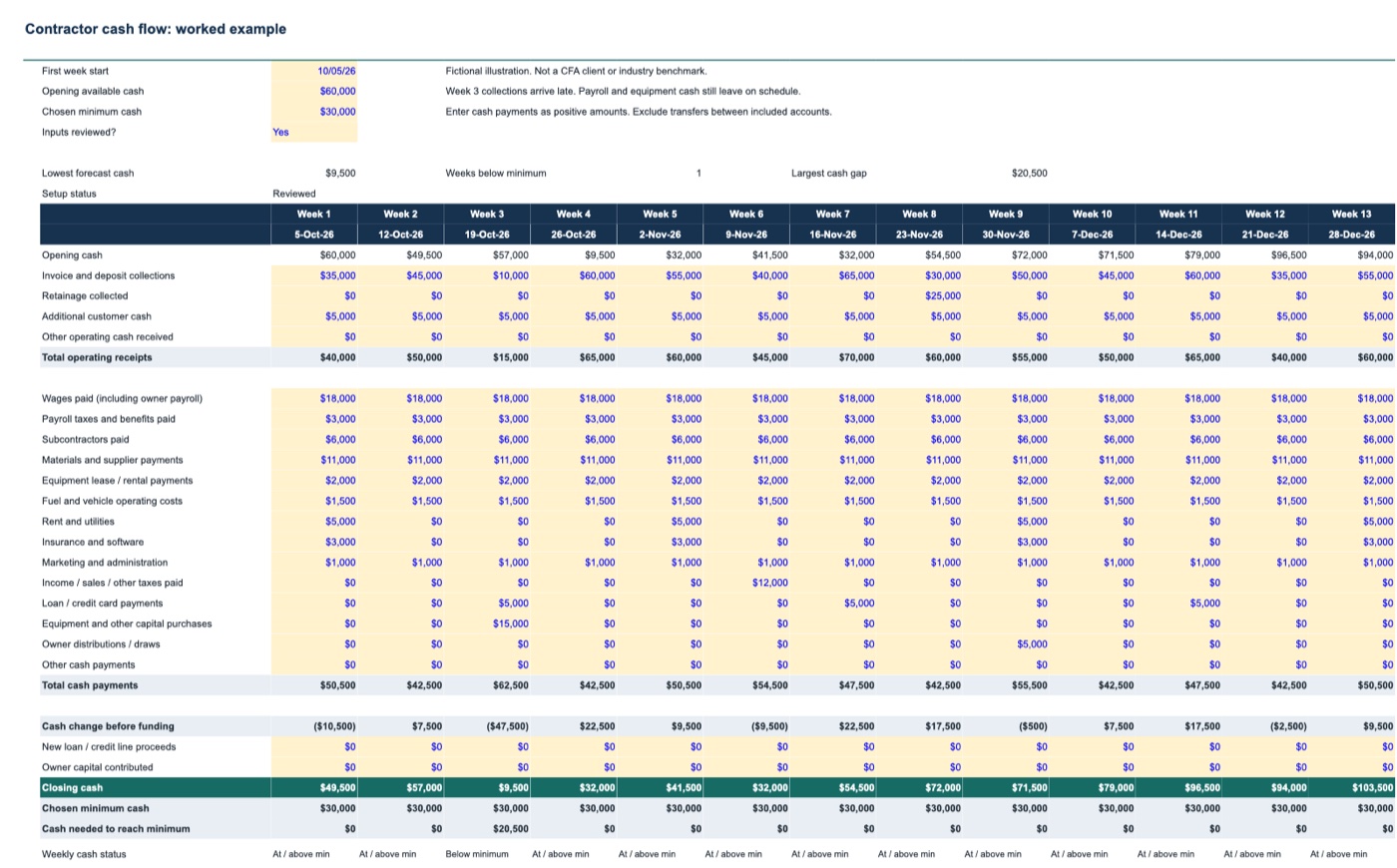
- Cash gap indicators: see the lowest projected closing balance, weeks below your chosen minimum, and the largest gap against that minimum.
- A worked example: fictional contractor numbers showing how delayed collections can create a shortage even while jobs keep moving.
- Instructions: setup guidance, common omissions, double-counting checks, and a weekly refresh process.
How to build your first forecast
1. Set your starting cash
Choose a first week start date. Enter the unrestricted bank cash available immediately before that week begins. Define which accounts and obligations you are including. Transfers between accounts already included in the forecast do not create new cash.
Set a minimum cash balance based on your obligations and timing risks. The example's minimum is a teaching assumption, not a recommendation for your business.
2. Schedule realistic collections
List the amounts still outstanding, not the original invoice amounts if customers have already paid part of them. Use one row for each expected payment. Split installments and retainage into separate rows.
If an invoice is due Friday but the customer normally pays two weeks late, use your best estimate of the actual receipt date. Add a note explaining the assumption and the next follow-up. The workbook counts each dated receipt in full. Its confidence field is a review note, not a probability adjustment.
3. Enter cash payments by week
Include wages, employer payroll costs, subcontractors, materials, equipment rentals, fuel, overhead, taxes, debt payments, equipment purchases, and owner distributions. Use the week the cash is expected to leave the bank.
Be careful with credit cards. If you pay for materials with a card and settle the card later, counting both the purchase and the card payment as bank outflows overstates the cash leaving your business.
4. Review closing cash and the gap
The workbook calculates:
The cash gap compares closing cash with your chosen minimum. It does not automatically add borrowing or assume a lender will approve funding. If a week falls short, examine the timing and identify the specific decisions that need attention.
5. Update it every week
Save a dated copy before making changes. Compare the completed week with bank activity. Replace opening cash with actual available cash, update customer payment dates, remove amounts already collected, and add another week of estimates.
Follow the workbook's refresh instructions. Changing the start date alone does not move manually entered payments into the correct weeks.
A simple timing example
Suppose a contractor starts a week with $50,000, expects $40,000 in customer payments, and must pay $45,000 in wages, suppliers, and other commitments. Expected closing cash is $45,000.
If $30,000 of those customer payments arrive a week later, closing cash falls to $15,000. With a chosen $25,000 minimum, that creates a $10,000 gap for the week. The jobs have not necessarily become less profitable. The collection timing changed.
These figures are illustrative. The workbook contains a separate, more detailed fictional example that you can edit to test payment delays.
Download the Free Excel ToolkitCommon questions
Enter expected customer payments. Revenue recognized on your profit and loss statement may not yet be cash in your bank account.
Enter it separately from ordinary invoice collections. Use the expected cash release date and avoid counting the same amount in both an invoice row and a retainage row.
Not necessarily. A weekly forecast can hide a midweek shortage when payroll goes out before a customer payment arrives. Review daily timing when balances are tight.
Yes. Save a copy, move that customer's expected receipt date later, and compare the affected weeks. Do not leave the original payment in the forecast as well.
No. Job costing helps you understand profitability. This forecast helps you understand cash timing. You need both to make informed decisions about pricing, capacity, and growth.
Get help applying it to your business
CEO Finance Academy provides financial coaching and Fractional CFO services for business owners who want clearer margins, cash flow, and growth decisions. If you run a construction or trades business and want help interpreting your numbers, book a no-cost Cash Flow Forecast Call.
→ Book a No-Cost Cash Flow Forecast CallFree call · No sales pressure · Just an honest look at your numbers
Learn about Fractional CFO services for construction companies.
Related guides
Building better Business Owners through personalized Financial Coaching.