
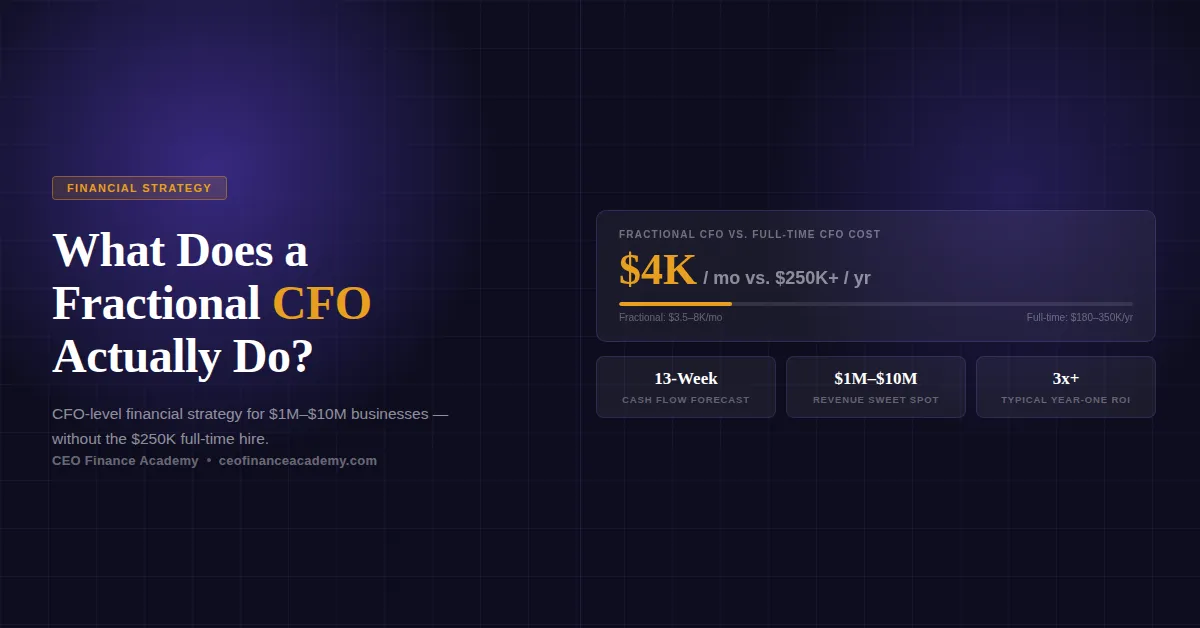
What Does a Fractional CFO Do? Duties, Cost & First 90 Days
If you're running a business doing $1M to $10M in revenue and you've started to feel like your financials are getting harder to manage, that your bookkeeper can't quite answer the questions you're actually asking, and your accountant only shows up at tax time, you've probably heard the term "fractional CFO" come up.
But most business owners aren't entirely sure what a fractional CFO actually does. Is it just a part-time finance person? A glorified bookkeeper? A consultant who builds spreadsheets and disappears?
A fractional CFO is none of those things. They are the financial co-pilot your business needs to make decisions with clarity instead of guesswork, without the $250,000+ cost of a full-time CFO.
This post is going to answer the question directly: what does a fractional CFO do, what don't they do, how are they different from the other financial people you already have, and how do you know if your business actually needs one. We'll also cover what it typically costs and what to look for when evaluating one.
What Is a Fractional CFO?
A fractional CFO is an experienced Chief Financial Officer who works with your business on a part-time or contract basis, typically a set number of hours per month, rather than as a full-time employee. The "fractional" refers to the fraction of their time you're purchasing, not a fraction of the expertise or value they bring.
The role exists because most growing businesses, companies doing $1M to $20M in revenue, have outgrown what a bookkeeper and accountant can provide, but aren't yet at the size where a full-time CFO is economically justified. A full-time CFO at a mid-market company commands $180,000 to $350,000 in salary plus benefits. A fractional CFO delivers most of the same strategic value at a fraction of that cost.
Quick Definition
A fractional CFO provides CFO-level financial strategy, forecasting, and decision support to growing businesses on a part-time basis. They typically work with multiple clients simultaneously and charge a monthly retainer, usually $2,000 to $8,000 per month depending on scope and business complexity.
The fractional CFO model has grown significantly over the past decade as more businesses recognize that the gap between "bookkeeper" and "full-time CFO" is exactly where most financial decisions and most financial mistakes actually happen. If you keep seeing terms like part-time, outsourced, virtual, or interim CFO and wondering how they differ, our guide to fractional vs. part-time vs. outsourced vs. interim CFOs breaks it down.
What a Fractional CFO Actually Does: The Core Responsibilities
The specific work varies by business and engagement scope, but the core responsibilities of a fractional CFO fall into eight categories:
1. Cash Flow Forecasting and Management
This is typically the highest-impact work a fractional CFO does for a growing business. They build and maintain a rolling cash flow forecast, usually 13 weeks out, that maps every expected receipt and payment so you can see cash crunches before they happen. Instead of checking your bank account and hoping for the best, you have a forward-looking view of exactly where your cash position is heading and enough lead time to make decisions about it.
2. Financial Reporting That Actually Means Something
Most small business owners receive a monthly P&L from their bookkeeper or accountant. What they don't receive is an interpretation of what it means, how it compares to targets, and what decisions it should inform. A fractional CFO builds a reporting structure that gives you the numbers you actually need to run the business: margin by service line, overhead as a percentage of revenue, revenue per employee, cash conversion cycle. They review these with you regularly so you understand what you're looking at.
3. Budgeting and Financial Planning
A fractional CFO builds your annual budget and financial plan, not just as a static document, but as a living tool you actually compare actuals against every month. They help you set revenue targets, model different growth scenarios, plan for hiring and capital expenditures, and make sure that the financial plan aligns with where you want the business to go. Without this, most owners are making growth decisions based on optimism rather than math.
4. Strategic Financial Decision Support
This is the work that's hardest to describe but often the most valuable. It's the conversation before you sign a major contract: does this job actually pencil out? Before you make a hire: can the business support this right now, and what revenue do we need to justify it? Before you take on debt: what does this actually cost us and how does it affect cash flow? A fractional CFO is the person in your corner who can model the financial implications of a decision before you make it, not after.
5. Financial Systems and Infrastructure
Many growing businesses are running on financial infrastructure that made sense at $500K in revenue but is causing real problems at $3M. Messy chart of accounts, no job costing, QuickBooks set up by someone who learned it on YouTube, no separation between personal and business finances. A fractional CFO cleans up the foundation, the accounting structure, the reporting setup, the dashboards, so that the numbers you're looking at are actually reliable.
6. Pricing Reviews and Margin Protection
A fractional CFO audits your price book against your actual fully-loaded costs: labor, burden, overhead, materials, and your target profit margin. In most companies this review reveals that 15% to 25% of jobs are underpriced relative to their true cost. Fixing those gaps often adds $50,000 to $150,000 in annual gross profit without a single new customer.
7. Oversight of Your Bookkeeper and CPA
Your bookkeeper and CPA still do their jobs. The fractional CFO makes sure their work is accurate, timely, and structured to produce useful management reports. If your books are consistently four to six weeks behind, they fix that. If your chart of accounts doesn't support departmental reporting, they restructure it. The fractional CFO is the quality-control layer between your accounting team and your decisions.
8. Owner Compensation Planning
Most owners either pay themselves too little or take erratic draws based on what's in the account. A fractional CFO sets the right owner compensation level for your revenue, margins, and growth stage, and structures regular distributions so your personal income is predictable and your business reserves stay healthy.
What the First 90 Days With a Fractional CFO Look Like
Most fractional CFO engagements follow a consistent pattern in the first three months.
Weeks 1–2: The financial assessment
The fractional CFO reviews everything: 12 to 24 months of P&Ls, your balance sheet, cash flow patterns, chart of accounts, pricing, AR aging, debt schedule, and bookkeeping setup. They identify the obvious issues (pricing gaps, overhead creep, slow collections, no departmental visibility) and the structural ones (late books, a chart of accounts that can't support useful reporting, personal and business expenses mixed together). At the end, you get a clear, plain-language picture of where the business stands, with a dollar amount attached to each problem.
Weeks 3–6: Building the foundation
This is where the systems get built: the 13-week cash flow forecast, a restructured chart of accounts for departmental reporting, a weekly KPI dashboard, margin benchmarks by service type, and a target for owner compensation. By week six you have the financial infrastructure most $1M to $5M businesses lack.
Weeks 7–12: Recommendations and an ongoing rhythm
Now the recommendations get specific: reprice these three service categories, shift marketing toward this higher-margin work, hold off on that hire until revenue per technician improves, accelerate collections on this slow-paying client, build reserves before committing to the new truck lease. Regular meetings settle into a rhythm of reviewing the dashboard, updating the forecast, and working through upcoming decisions, and each one produces two or three specific action items.
What a Fractional CFO Does NOT Do
This is just as important to understand as what they do. A fractional CFO is not:
A bookkeeper. They do not enter transactions, reconcile accounts, or manage day-to-day accounting. That work should already be happening. A fractional CFO works from clean books; they don't create them.
A tax preparer or CPA. They are not filing your taxes or providing tax advice. You still need an accountant for that. The fractional CFO works with your accountant but serves a completely different function.
A controller. A controller manages the accounting function, making sure the books are accurate and compliant. A fractional CFO works above that layer, using the financial data to drive strategy and decisions.
A full-time employee. They are not available 40 hours a week. A typical fractional CFO engagement is 10 to 20 hours per month. They're highly available for scheduled work and key decisions, but they're not a resource you tap for daily questions.
A magic fix for a broken business. A fractional CFO can dramatically improve financial clarity and decision-making. They cannot fix a business that has fundamental operational or market problems. Financial visibility surfaces those problems; it doesn't solve them on its own.
Fractional CFO vs. Bookkeeper vs. Accountant: The Key Differences
This is the comparison most business owners need to see clearly before they can understand the value of a fractional CFO. These three roles are not interchangeable. They each operate at a different layer of your financial function.
Role | Primary Function | Time Orientation | Typical Cost | Answers the Question |
|---|---|---|---|---|
Bookkeeper | Records and categorizes transactions | Past (what happened) | $500–$2,500/mo | "What did we spend?" |
Accountant / CPA | Tax compliance, financial statements | Past (annual review) | $2,000–$10,000/yr | "What do we owe in taxes?" |
Controller | Manages accounting accuracy and compliance | Past + present | $3,000–$6,000/mo | "Are the books accurate?" |
Fractional CFO | Financial strategy, forecasting, decision support | Present + future | $2,000–$8,000/mo | "What should we do next?" |
The most important distinction is time orientation. Your bookkeeper and accountant are looking backward, recording and reporting what already happened. A fractional CFO is looking forward, helping you anticipate what's coming and make better decisions about it. Both are necessary. Most growing businesses have the backward-looking layer covered. The forward-looking layer is the gap.
Your bookkeeper tells you where your money went. Your fractional CFO tells you where it's going and what to do about it before it gets there.
What a Fractional CFO Does for Contractors and Trades Businesses
For owners in the trades, the fractional CFO role isn't just useful. It's often the difference between a business that scales sustainably and one that grows itself into a cash crisis.
Roofing, HVAC, construction, and other trade businesses face financial challenges that most generic financial advice doesn't account for: seasonal revenue swings, long payment cycles, job-level cost variability, and the constant tension between booking more work and having enough cash to fund it. A fractional CFO who understands the trades brings specific capabilities that directly address these patterns.
Job Costing and Margin by Work Type
A monthly P&L tells you how the whole company did. It doesn't tell you which jobs are making money and which are quietly eroding your margins. A fractional CFO implements job-level costing so you know your gross margin on residential versus commercial work, service calls versus installations, and which crews are most profitable. This single insight changes how most trades owners price, bid, and prioritize their work.
If you run a roofing or HVAC business and haven't looked at your margin by job type, the gap between your best and worst-performing work may surprise you. For a deeper look at what healthy margins should look like in your trade, see our guides on roofing company profit margins and HVAC business profit margins.
Managing the Feast-or-Famine Cash Cycle
Most trade businesses are highly seasonal. Revenue surges in peak months and drops in slower periods, but overhead runs 12 months a year. A fractional CFO builds the cash flow forecasting system that makes this predictable instead of painful. You know when the slow period is coming, how much cash you need to carry through it, and how to build that reserve during peak season.
This is one of the most common cash flow problems we see in construction businesses specifically. If you want to understand the mechanics of why profitable contractors often feel cash-strapped, our post on construction cash flow problems walks through the six structural patterns that cause it.
Billing, Collections, and Working Capital
In the trades, cash timing is everything. Material costs and labor hit your account before the invoice is paid. A fractional CFO helps you tighten your billing cycle, structure deposits on larger jobs, and reduce the gap between work completed and cash collected. On a $3M to $5M business, shortening that cycle by even two to three weeks can free up $100,000 or more in working capital.
Trades-Specific Note
The fractional CFO services at CEO Finance Academy were built specifically for owner-operated trade and home service businesses. Our work with 225+ coached companies in roofing, construction, HVAC, plumbing, and adjacent trades means we bring industry-specific benchmarks, not generic financial templates, to every engagement.
For owners in construction, excavation, and specialty contracting, we also offer a fractional CFO service built specifically for construction companies, including job costing, WIP and underbilling reviews, and retainage tracking.
Real Examples: What a Fractional CFO Does in Practice
Abstract descriptions only go so far. Here's what fractional CFO work has produced in real businesses.
HVAC company, $2.2M revenue
The fractional CFO split the P&L into residential service, installations, and maintenance agreements. The owner discovered installations were running at a 28% gross margin (he thought it was 40%) because material costs had risen 18% over two years and the price book hadn't been updated. Service work ran at 56% but was only 30% of revenue. Updating the price book added about $95,000 in annual gross profit, and shifting marketing toward service and maintenance agreements took net margin from 7% to 14% over 12 months.
Plumbing company, $1.5M revenue
The 13-week cash flow forecast revealed a $42,000 gap in week nine, when payroll, quarterly taxes, and the workers' comp renewal all landed at once. With eight weeks of lead time, the owner accelerated two large receivables, delayed a truck upgrade by a month, and set up a short-term credit line as a backup. What would have been a panicked Thursday night became a calm Monday planning conversation.
Staffing agency, $3.5M revenue
An audit of bill rates against actual burden costs found that 22% of placements were priced below their true cost once category-specific workers' comp rates were applied. Repricing at contract renewal added about $130,000 in annual gross profit.
Construction company, $4M revenue
The owner was considering a second location. The fractional CFO modeled lease, equipment, staffing, marketing, insurance, and ramp-up and found the new location would be cash-flow negative for 14 months and need $180,000 in working capital the business didn't have. Instead, the company maximized its current location's capacity. Revenue grew 22% the next year and net margin improved from 6% to 11%.
7 Signs Your Business Needs a Fractional CFO
Not every business needs a fractional CFO right now. Here are the specific signals that indicate you've reached the point where the role pays for itself:
For a stage-by-stage breakdown of what financial help fits your revenue, see when a small business needs a CFO.
You're profitable on paper but constantly stressed about cash. This is the clearest signal. If your P&L shows profit but your bank account feels tight, you have a cash flow visibility problem, exactly what a fractional CFO solves first.
You're making major financial decisions without confidence. Hiring, equipment, new locations, taking on debt: if these decisions feel like educated guesses rather than informed choices, you need someone who can model the financial implications before you commit.
Revenue is growing but profit isn't keeping up. Growing from $2M to $4M in revenue without a proportional increase in net income is a systems problem. A fractional CFO identifies where the margin is leaking and builds the visibility to fix it.
Your bookkeeper can't answer your real questions. "What can we afford to pay ourselves?" "Can we take on this new contract?" "When will we run out of cash if the slow season is worse than last year?" If you're getting blank stares or "talk to your accountant," you need a different resource.
You don't know your key financial metrics. Gross margin, overhead ratio, cash conversion cycle, revenue per employee: if these numbers aren't part of your monthly review, you're running blind at a level of complexity that requires better visibility.
You're preparing for a significant growth phase. Scaling a business without financial infrastructure in place is one of the most common ways fast-growing companies get into trouble. A fractional CFO builds the financial foundation before you need it, not after.
You're considering outside investment, an acquisition, or an exit. Any of these events requires clean, credible financial reporting and a CFO-level narrative around your numbers. Trying to prepare for due diligence without a CFO is like going to court without a lawyer.
Revenue Guideline
As a general benchmark, businesses typically reach the inflection point for fractional CFO value somewhere between $1M and $3M in annual revenue, when financial complexity has outpaced what a bookkeeper and annual accountant can manage, but the business isn't yet large enough to justify a full-time CFO hire.
Not Sure If You're Ready for a Fractional CFO?
Book a free Cashflow Forecast Call with our team. We'll look at your numbers together and tell you honestly whether a fractional CFO makes sense for where your business is right now.
No sales pressure · Just an honest look at your numbers
Fractional CFO or Financial Coaching: Which Do You Need?
Not every business that needs better financial visibility needs a fractional CFO. Some need a better bookkeeper, and some are better served by a financial coach who teaches them to run the numbers themselves.
A fractional CFO is usually the right fit if:
You're doing roughly $3M or more and the complexity (multiple service lines, 15+ employees, hard-to-predict cash flow) has outgrown your bookkeeper and CPA.
You're making hiring, equipment, expansion, or pricing decisions without financial modeling.
Your books are accurate but nobody is analyzing them or connecting them to decisions.
You're planning to sell or scale significantly in the next two to five years.
Financial coaching is usually the better fit if:
You're doing $500K to $3M and want to learn to understand your own numbers rather than outsource the thinking.
You want someone to walk you through how to read your P&L until it clicks.
You need the habits (weekly reviews, cash forecasting, margin tracking) more than the infrastructure.
Your budget doesn't support a fractional CFO yet.
Businesses between $2M and $4M often fit either model. The right choice depends on whether you want to build the skills yourself or have someone manage the strategy for you. If you're not sure where you fall, start with our guide to the 10 signs your business has outgrown your bookkeeper.
What Does a Fractional CFO Cost?
Fractional CFO pricing varies based on scope, business complexity, and hours engaged. Here's what the market looks like:
Engagement Level | Typical Hours/Month | Monthly Cost | Best For |
|---|---|---|---|
Light / Advisory | 5–10 hrs/mo | $1,500–$3,000 | Businesses at $500K–$1.5M, need direction but not deep engagement |
Standard Engagement | 10–20 hrs/mo | $3,000–$6,000 | Businesses at $1.5M–$5M with active growth and financial complexity |
Deep Engagement | 20–40 hrs/mo | $6,000–$12,000 | Businesses at $5M–$20M, fundraising, acquisition, or rapid scaling |
Full-Time CFO | Full-time | $15,000–$30,000/mo | Businesses at $20M+ with full internal finance function |
The ROI calculation is usually straightforward: a fractional CFO at $4,000 per month who helps you identify $150,000 in margin improvement over 12 months has returned 3x their cost in year one, before accounting for better cash management, avoided bad decisions, and the compounding value of actually understanding your numbers.
The more relevant question isn't "can we afford a fractional CFO?" It's: "what is the cost of the decisions we're making right now without one?"
For a full breakdown of pricing models, what drives the differences, and how to evaluate a quote, see our guide to how much a fractional CFO costs. If you're comparing providers, our complete guide to fractional CFO services covers what's usually included, how engagements are structured, and how to tell if you need one.
What to Look for in a Fractional CFO
Not all fractional CFOs are the same. Here's what actually matters when evaluating one:
Industry experience with businesses your size
A CFO who spent 20 years at Fortune 500 companies may not be the right fit for a $3M service business. The financial challenges, the systems, and the decision frameworks at your revenue level are different from what a corporate CFO navigates. Look for someone who has worked extensively with owner-operated businesses in your revenue range, ideally in your industry or an adjacent one.
They work from your actual numbers, not templates
Be cautious of fractional CFOs who show up with a standard dashboard and apply it uniformly to every client. The best fractional CFOs build their analysis around your specific business, your revenue model, your cost structure, your growth goals. The deliverables should reflect your business, not a generic financial package.
They communicate in plain language
Financial expertise is only useful if it translates into decisions you can actually make. A good fractional CFO can explain what your numbers mean in clear, direct terms, not just produce reports. If you leave a meeting with your fractional CFO more confused than when you arrived, that's a problem.
They're proactive, not just responsive
You don't want a fractional CFO who only shows up when you call them with a problem. The value is in proactive identification of risks and opportunities: someone who reviews your numbers every month and brings you insights before you ask for them. Ask prospective fractional CFOs how they typically communicate between formal meetings and what they do when they spot something that needs attention.
How CEO Finance Academy's Fractional CFO Program Works
At CEO Finance Academy, our fractional CFO tier was built specifically for owner-operated businesses doing $600K to $20M in revenue, the exact stage where the gap between bookkeeper and full-time CFO is most costly.
Here's what our CFO clients get:
A custom CFO Dashboard built around their specific business, not a generic template
Monthly financial review calls where we walk through the numbers and tell you exactly what they mean
A rolling 13-week cash flow forecast updated and reviewed regularly
Job-level profitability analysis so you know which work is actually making money
Owner pay structure, making sure you're paying yourself correctly and sustainably
On-call access for financial decisions, so you never make a major call without running it through the numbers first
Direct access to our full financial methodology: the Certainty System, built from working with 225+ coached companies
Our CFO clients pay $3,500 to $6,000 per month depending on scope. The most common thing we hear from them in the first 90 days: "I can't believe I was making decisions without this."
See the full details on our fractional CFO services page, or if you'd rather learn to manage your own numbers, our weekly coaching program.
Fractional CFO FAQs
What does a fractional CFO do?
A fractional CFO provides part-time, CFO-level financial leadership. They build and maintain a rolling cash flow forecast, create reporting such as departmental P&Ls and KPI dashboards, lead budgeting and financial planning, model major decisions like hiring and equipment purchases before you commit, review pricing, oversee your bookkeeper and CPA, and plan owner compensation.
How much does a fractional CFO cost?
Most fractional CFOs charge a monthly retainer, typically $2,000 to $8,000 per month depending on scope and business complexity. Light advisory engagements start around $1,500 to $3,000 per month, while deep engagements for larger or fast-scaling companies can run $6,000 to $12,000 per month. A full-time CFO costs $180,000 to $350,000 or more per year.
How many hours does a fractional CFO work?
A typical fractional CFO engagement is about 10 to 20 hours per month, usually with regular review meetings once or twice a month. Lighter advisory engagements can be 5 to 10 hours per month, and deeper engagements 20 to 40 hours.
What is the difference between a fractional CFO and a bookkeeper?
A bookkeeper records and categorizes transactions, which tells you what already happened. A fractional CFO uses that data to look forward: forecasting cash, analyzing margins, and helping you decide what to do next. A fractional CFO works from clean books; they don't replace your bookkeeper or CPA.
When does a business need a fractional CFO?
Most businesses reach the point where a fractional CFO pays for itself somewhere between $1M and $3M in revenue, when they're profitable on paper but tight on cash, growing revenue without growing profit, making major decisions without financial modeling, or preparing for growth, investment, or a sale.
What does a fractional CFO do in the first 90 days?
In the first two weeks, they assess your financials and identify the biggest issues. In weeks three to six, they build the foundation: a 13-week cash flow forecast, departmental reporting, a KPI dashboard, and margin benchmarks. From week seven on, they make specific recommendations and settle into a regular review rhythm.
The Bottom Line: What Does a Fractional CFO Do?
A fractional CFO is the forward-looking financial layer that most growing businesses are missing. While your bookkeeper records what happened and your accountant handles taxes, a fractional CFO helps you understand where your business is going financially and how to make better decisions about it before you get there.
They build and maintain your cash flow forecast. They give your financial reports meaning. They model the implications of major decisions before you make them. They build the financial infrastructure your business needs to scale without falling apart. And they do all of it at a fraction of the cost of a full-time CFO hire.
If your business is between $1M and $10M in revenue and you're making financial decisions based on gut feel, checking your bank balance before committing to anything, or just not sure where your money is going, that's the gap a fractional CFO fills.
Ready to Have a CFO in Your Corner?
Book a free Cashflow Forecast Call with our team. We'll look at your numbers together, show you exactly where the gaps are, and tell you whether our fractional CFO program is the right fit.
Free call · No sales pressure · Just an honest look at your numbers