
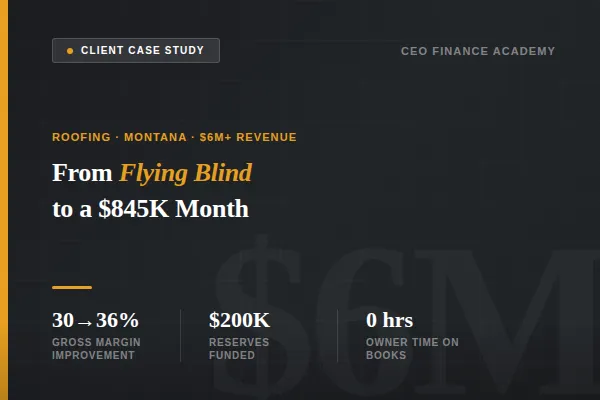
How a $6M Montana Roofing Franchise Owner Got Real Financial Visibility
A roofing franchise owner in Montana scaled his business from zero to over $6 million in completed revenue in just three years. He built a team of 12 W-2 employees and several subcontractor crews. His franchise was named Franchise of the Year.
From the outside, everything looked like it was working. From the inside, the financial picture told a different story.
"My QuickBooks says our net profit for the year is $75,000 out of $3.6 million in sales. That's not good. I just want to make sure we maintain a profitable business. That's my main concern. I want to keep the doors open for everybody to have jobs."
He knew his numbers weren't telling him the truth. He'd gone through four bookkeepers in three years. Customer deposits on his balance sheet had ballooned to over $700,000, a figure he knew was wildly inaccurate. His P&L would swing hundreds of thousands of dollars from one month to the next, and he couldn't explain why. He was paying $3,000 a month for bookkeeping services that still hadn't cleaned up the mess.
He didn't need someone to lecture him about profit margins. He needed a partner who could walk into his books, understand his business, and actually fix things.
Where He Started: A $6M Business Flying Blind on Financials
He came into CEO Finance Academy with clear goals: increase net profit, build repeatable financial systems, and stop fighting with unreliable bookkeeping. His CFA coach started with a full accounting assessment of his QuickBooks, walking through the P&L line by line and the balance sheet account by account.
What they found wasn't catastrophic, but it was messy in ways that made it nearly impossible to make confident decisions. Sales commissions weren't categorized as a direct cost. Franchise royalties were tangled up with rebates that kept changing structure. Vehicle expenses were misclassified. A previous bookkeeper had created a $349,000 depreciation adjustment with no explanation. And that $700,000 customer deposits balance? Years of sloppy data entry from a franchise-affiliated bookkeeping service that had never properly closed out completed jobs.
His books weren't broken in one dramatic way. They were broken in dozens of small ways that compounded over three years and four different bookkeepers. The result: he couldn't trust any number his system produced, and he was spending hours every week doing data entry that wasn't his job.
When his CFA coach looked at the P&L and the balance sheet together, she told him something he already suspected but hadn't heard from anyone else: his books weren't as complicated as previous providers had claimed. The chart of accounts was well organized. The integrations between his CRM (AccuLynx) and QuickBooks were functional. The real issue was that no one had taken ownership of making the system work consistently.
Getting the Real Numbers: Gross Margins, Baseline Expenses, and Cash Flow
Over the first several weeks, they built out his finance dashboard from scratch. They started with gross margins, carefully separating materials, subcontractor labor, sales commissions, and franchise royalties so he could see what each dollar of revenue actually cost.
The initial gross margin calculation came in around 30%, which aligned with what his P&L was showing. But as they dug deeper, they discovered that the margin had actually improved to closer to 36% in recent months, driven by cost reductions he had already implemented on the operations side.
"I've always thought we were at like a 3% or 4% net profit. It's better than I originally thought, which has me wondering if we're missing something."
They weren't missing something. The confusion came from how the franchise royalty structure (which had changed three times in as many years) was distorting the P&L, combined with a large depreciation journal entry that made the books look worse than reality. Once the royalty rebates were reconciled and one-time adjustments separated from recurring expenses, the business was actually operating at closer to 8% net margin on a normalized basis.
They also mapped out his baseline expenses, identifying which costs were truly fixed, which were seasonal, and which could be turned off in a cash crunch. Marketing was the biggest surprise: he had been spending $180,000 annually without realizing it, spread across a dozen channels with inconsistent tracking.
Before and After: Financial Visibility at a Glance
| Area | Before CFA | After CFA |
|---|---|---|
| Bookkeeping cost | $3,000/mo (external, unreliable) | ~$500/mo (local bookkeeper, CFO-managed) |
| Customer deposits accuracy | $700K+ (years of unclosed entries) | Reconciled to $441K with line-by-line audit |
| Gross margin visibility | ~30% estimated, no breakdown by service | 36% confirmed, tracked by roofing/siding/gutters/windows |
| Net profit understanding | "QuickBooks says $75K... that's not good" | ~8% normalized, with clear drivers identified |
| Owner time in books | Hours per week on data entry and bill pay | Zero data entry; reviews dashboard twice/month |
| Cash flow planning | Reactive, no reserves structure | Wealth Waterfall with tax, growth, and operating reserves |
Building the Financial Operating System
With the numbers finally trustworthy, they shifted to building systems that would keep them that way. They set up a Wealth Waterfall process: a monthly exercise that starts with the bank balance, accounts for every upcoming obligation (vendor bills, credit card payments, sales commissions, debt principal), and then allocates what's left to tax savings, growth reserves, and owner distributions.
He funded two new savings accounts with $100,000 each, one for taxes and one for general business reserves. For the first time in the life of the business, cash wasn't sitting in one undifferentiated pile.
They also documented the six core financial processes every business needs: collecting cash, paying bills, running payroll, managing credit cards, closing the books monthly, and saving for taxes. His goal was to get every one of those processes off his plate and into the hands of someone else, with him serving as the reviewer rather than the doer.
He went from being the person entering bills in QuickBooks to being the person who reviews a financial summary and makes strategic decisions. That shift happened within the 12-week coaching program and deepened further when he moved into ongoing fractional CFO services.
Running a Multi-Million Dollar Business Without Clear Financials?
Let's look at your numbers together and find out where the opportunity is sitting.
→ Book My Free CallNo sales pressure · Just an honest look at your numbers
Solving the Bookkeeping Problem Once and For All
One of the most persistent frustrations in his business was bookkeeping. He'd cycled through a franchise-mandated bookkeeping service, a personal contact, an external firm, and an expensive CPA/bookkeeper combo — none of which had delivered reliable books.
Through the coaching process, his CFA coach helped him recognize that he didn't need one person to do everything. He needed a bookkeeper who could handle data entry and reconciliation, a CPA for tax filing, and a fractional CFO to oversee the whole picture and make sure nothing fell through the cracks.
The turning point came when a local bookkeeping firm moved into the office next door. He walked over, showed them his QuickBooks, and they quoted roughly four to five hours a month at $95/hour — roughly $500 per month. That was a fraction of what he'd been paying, and his CFA coach would serve as the quality control layer between the bookkeeper, the CPA, and the owner.
"If that truly is how the CFO thing works, where I can just say, 'Hey, work with the bookkeeper, let me know what your questions are, we'll meet twice a month,' and that's my bookkeeping involvement? Sign me up."
Using Financial Clarity to Make Bigger Decisions
With reliable numbers in hand, he started using his finance dashboard to evaluate real growth decisions. They ran a return-on-investment analysis on purchasing metal fabrication equipment (a $200,000 CNC brake) versus continuing to outsource trim work to a supplier. The analysis showed roughly $20,000 in annual material savings against $29,000 in annual equipment costs, but with depreciation benefits and the potential to increase metal roofing volume, the payback period came in around 10 years.
They also modeled buying commercial real estate versus continuing to lease. He was paying over $7,000 per month across multiple locations. Purchasing a property with an SBA loan would cost roughly the same per month but build equity and provide depreciation benefits. When his CFA coach ran the numbers, the deal was cash-flow positive from day one.
Perhaps most significantly, they built out a capacity-versus-demand analysis for every department: sales, production (broken down by shingle, metal, TPO, siding, gutters, and windows), and administration. This gave him concrete data to support decisions about hiring, about which services to push harder, and about where the real bottlenecks were in his business.
The capacity analysis revealed that his sales team had plenty of room. The real constraint was his two on-site supervisors, whose ability to manage job sites limited how many projects the crews could run simultaneously. That insight reframed the hiring conversation entirely.
Where He Stands Today
He completed the 12-week CFA coaching program and transitioned into ongoing fractional CFO services. Here's what that progression has produced:
He is now expanding into three new Montana territories, hiring additional sales and production staff, and evaluating an investment partnership offer that would value his company at a multiple of EBITDA. He received an unsolicited Letter of Intent from investors who saw the growth trajectory and operational maturity of what he'd built.
He went from spending his days entering bills in QuickBooks to receiving a weekly financial summary email every Friday, reviewing budget-versus-actual with his CFO twice a month, and focusing his energy on the strategic decisions that actually grow the business.
What Changed: Having Someone in the Co-Pilot Seat
He had an MBA. He wasn't unfamiliar with financial concepts. What he lacked was someone who would get into the weeds of his specific business, hold his bookkeeper accountable, catch the errors his CPA missed, and translate all of it into decisions he could act on.
That's the gap a coaching program and fractional CFO relationship fills. It's not about teaching theory. It's about building the dashboard, cleaning the books, setting up the reserves, modeling the growth scenarios, and then showing up every two weeks to make sure the plan is working.
"I've always set this business up from day one wanting to be able to step aside and let it run itself. The finance piece was the last thing holding me back."
The Bottom Line
This roofing franchise owner didn't have a revenue problem. He had a visibility problem. His business was generating millions in sales but he couldn't answer basic questions: What's my real net margin? Can I afford this hire? Is my commission structure sustainable at $10 million? Should I buy or lease this property?
After working with CEO Finance Academy, he can answer all of them.
- Gross margin improved from ~30% to 36% through better cost tracking and operational adjustments
- Bookkeeping costs dropped from $3,000/month to roughly $500/month with better results
- Customer deposits reconciled for the first time in the life of the business
- Cash reserves structured across dedicated tax, growth, and operating accounts
- Capacity analysis built for every department, directly informing hiring and expansion decisions
- An unsolicited acquisition offer received, with financial documentation ready for due diligence
That's what happens when a business owner stops guessing and starts building real financial infrastructure. And that's exactly what we help contractors and home service companies do at CEO Finance Academy.
Ready to See What's Possible for Your Business?
Whether you're at $2M or $10M, the first step is the same: let's look at your numbers together.
→ Book My Free CallFree call · No sales pressure · Just an honest look at your numbers